

The Commonwealth Home Support Programme (CHSP) is the government's answer for older Australians who are still managing well on their own but could use a bit of help to keep living independently at home. It's designed for those moments when you're mostly self-sufficient but find that a few specific tasks are becoming a bit much. The program is all about maintaining your well-being and staying connected to your community.
Understanding The Commonwealth Home Support Programme
Think of managing your home like looking after a garden. For years, you've handled it all, but maybe now, bigger jobs like mowing the lawn or heavy weeding are getting tricky. The Commonwealth Home Support Programme is like a friendly gardener who comes in to handle those specific jobs, so you can keep enjoying your home without feeling overwhelmed.
It’s about providing that foundational support to stop small challenges from turning into bigger problems. This isn't intensive, round-the-clock care; it's targeted help that makes a real difference in your day-to-day life. The goal is simple: to help you stay independent, safe, and connected.
The program's impact speaks for itself. Recently, the CHSP supported around 835,000 older Australians across the country. That's a significant 16% increase from the 723,000 people it helped back in 2016–17. This growth really highlights how vital the program is as a first step into aged care, supporting about three-fifths of all people using government-funded services.
What Does This Support Look Like In Practice?
CHSP services are practical and flexible. They focus on addressing specific needs rather than trying to overhaul your entire routine. The key is that support workers aim to do things with you, not just for you. This approach helps you maintain your skills and confidence. For example, instead of just cooking a meal, a support worker might help you chop the vegetables while you handle the stovetop, making the task manageable together.
Here are a few real-world examples of how the CHSP can lend a hand:
- A Bit of Housework: A support worker could pop in once a week to help with vacuuming or laundry if those tasks have become physically demanding.
- Getting Around: If you no longer drive, the program can arrange transport to get you to your doctor’s appointments or to your weekly social group.
- Staying Social: You might join a local, subsidised group for activities like gentle exercise, crafts, or community lunches, helping you stay active and in touch with others.

At its heart, the program aims to provide a consistent, national approach to this kind of entry-level support. It ensures that no matter where you live, you can access foundational services that help you stay independent and live well—much like the support you’d find at various independent living centres.
So, How Do You Know If You’re Eligible?
Figuring out if you or a loved one can access the Commonwealth Home Support Programme (CHSP) comes down to a few simple criteria. This program is all about providing entry-level support. Think of it as a helping hand for daily tasks, not for complex or constant care. It’s designed to help you stay independent in your own home for as long as possible.
The main requirement is age. Generally, you need to be 65 years or older. For Aboriginal or Torres Strait Islander people, this is lowered to 50 years or older, recognising different health and life expectancy outcomes.
Age is just the first step. The next piece of the puzzle is your actual need for help. The program is for people living at home who are finding certain daily tasks a bit of a struggle. This is where you can really see the difference between CHSP and higher-level care—it’s for those who are mostly getting by on their own but could use a bit of targeted assistance.
What Does Eligibility Look Like in Real Life?
Let's put this into perspective with a couple of real-world examples. The Commonwealth Home Support Program is perfect for people in situations like these:
- Arthur is 78. He loves pottering in his garden but finds pushing the heavy vacuum cleaner around the house completely wipes him out. He also has a tough time lugging the weekly shopping in from the car. He doesn’t need any personal care, just a hand with those physically demanding jobs.
- Helen is 82. She recently handed in her driver's licence but has regular medical appointments she can't miss. While she’s fine managing everything at home, she needs a safe and reliable way to get to her appointments without having to ask family every time.
In both of these scenarios, Arthur and Helen are still very independent. They don’t need nursing care or round-the-clock support. They just need a little boost with one or two specific activities. This is exactly what the CHSP is for—it bridges the gap before more intensive care becomes necessary.
The whole point is to offer the right amount of support at the right time. CHSP helps tackle small hurdles before they grow into major roadblocks, allowing you to live safely and comfortably in your own home.
The Official Assessment Process
You don’t just decide you’re eligible on your own; it needs to be confirmed through an official assessment. The entire system runs through My Aged Care, which is the Australian Government's main hub for all things aged care.
First, you’ll need to contact My Aged Care to get registered. They will then set up a home visit from an assessor who works for a Regional Assessment Service (RAS). Don’t worry, this isn’t a test—it’s just a friendly chat. The assessor is there to understand your situation, listen to your concerns, and figure out what support would make life a little easier.
During the visit, they'll work with you to create a support plan that aligns with your specific goals. For instance, if you mention you're worried about falling, they might suggest installing grab rails in the bathroom. If they find you’re eligible for the Commonwealth Home Support Program, they will approve you for certain services and give you referral codes to take to a provider you choose. This assessment makes sure the support you get is a perfect fit for your needs and is a key step in securing the right aged care funding.
What Kind of Help Can You Get with the CHSP?
The Commonwealth Home Support Programme offers a whole range of practical, entry-level services designed to give you a hand right where you need it most. The philosophy behind it is simple but powerful: it’s about working with you, not just doing things for you. This approach is all about helping you keep your skills, confidence, and independence at home for as long as possible.
All the available services are grouped into a few key areas, which makes it much easier to figure out what kind of support you can get. Whether it's a bit of help with household chores, some support for your health and wellbeing, or just a way to stay connected with your community, the CHSP has something to offer.

To make it even clearer, here's a quick look at the main types of support you can access through the CHSP.
| Service Category | What It Includes (Examples) | Who It Helps |
|---|---|---|
| Support in Your Home | Domestic help (cleaning, laundry), meal prep, home maintenance (changing lightbulbs, installing grab rails), gardening. | Anyone finding it physically difficult to keep up with daily household tasks. |
| Health & Personal Care | Help with showering/dressing, podiatry, physiotherapy, nursing care (wound care, medication management). | People who need a bit of help managing their personal health and wellness routines safely. |
| Community & Social Life | Social visits, group activities (exercise classes, lunches), transport to appointments or shops. | Those who want to stay active, engaged, and connected to their local community. |
This table just scratches the surface, but it gives you a good idea of how the CHSP provides a safety net of support, touching on all the different aspects of living well at home. Now, let's explore these categories in a bit more detail.
Support in Your Home
This is all about getting practical help with daily chores to keep your home safe, clean, and comfortable. Think of it as easing the physical load of tasks that have become a bit of a struggle, freeing up your energy for the things you actually enjoy.
Here’s what that looks like in real life:
- Domestic Assistance: A support worker might pop in for an hour each fortnight to help with heavier jobs like vacuuming the carpets and cleaning the bathroom, making the home easier for you to manage the rest of the time.
- Meal Preparation: If standing for long periods is getting tricky, you can have a support worker help prepare and freeze meals for the week, or you could get a service like Meals on Wheels to deliver a hot lunch daily.
- Home Maintenance: This covers those small but important jobs, like installing a grab rail in the bathroom, changing a hard-to-reach lightbulb, or fixing a leaky tap to prevent a fall.
- Gardening: A bit of help with the basics like mowing the lawn or weeding can make all the difference in helping you enjoy your garden without the risk of over-exertion.
These services are incredibly valuable. In fact, government data shows that domestic assistance is the most accessed service, with 838,694 users. It’s a clear sign of how much this kind of help matters to people who need support with daily tasks.
Health and Personal Care
This area is focused on helping you manage your personal health and wellbeing with the help of trained professionals. The services here are designed to maintain your physical health and mobility, so you can feel confident in your daily routines.
The core idea is to provide just enough support to help you stay well and manage your own care routines safely. This isn't about replacing your doctor but about offering practical assistance that complements your existing healthcare plan.
A support worker or health professional can assist with:
- Personal Care: This includes dignified and respectful help with daily self-care tasks like showering, dressing, and grooming. For example, a support worker might visit in the morning to help you safely get in and out of the shower.
- Allied Health and Therapy Services: You can access things like physiotherapy to improve balance and strength after a fall, podiatry for essential foot care, or occupational therapy to find easier ways to do daily activities, such as using a special tool to put on your socks.
- Nursing Care: A community nurse can visit to help with clinical tasks like managing your medication, caring for a wound after surgery, or checking your blood pressure.
This professional support ensures you can look after your health effectively while staying in the comfort of your own home. You can learn more about the specifics of in-home nursing and personal care services to see how they fit into the broader picture of home support.
Community and Social Life
Staying connected with friends and the local community is absolutely vital for our mental and emotional health. The CHSP recognises this by offering services specifically designed to prevent social isolation and help you stay active and engaged.
These services are all about creating opportunities to socialise, enjoy your hobbies, and simply get out of the house.
- Social Support: This could be a one-on-one visit from a support worker for a chat and a cup of tea, or to go with you to the local library. It can also be in a group setting.
- Organised Group Activities: Many providers run social groups based around activities like a weekly seniors' exercise class, a men's shed program, or a community bus trip for lunch—a great way to meet new people.
- Transport Services: If getting around is a challenge, this service can provide a car and driver to take you to your GP appointment, the local shops, or a family event so you don’t have to miss out.
By offering such a wide variety of support, the CHSP helps you build a network that truly meets your individual needs. From keeping your house in order to making sure you can get to your weekly exercise class, the program is a flexible and practical way to hold onto your independence and quality of life.
How to Apply for CHSP, Step by Step
Getting started with the Commonwealth Home Support Programme might feel like a big task, but the path is actually quite straightforward. Everything is designed to lead you to the right support, and it all begins in one place: My Aged Care. Think of it as the front door for all government-funded aged care in Australia.
This section is your roadmap. We’ll walk through each stage, from that first phone call to finding a provider. My goal is to clear up any confusion and show you what to expect, making the whole process feel much more manageable.
Starting Your Application with My Aged Care
Your very first step is to get in touch with My Aged Care. You can either register on their website or give them a call. To make things run smoothly, it helps to have a little bit of information ready before you start.
Before you dial or click, try to have these details handy:
- Your Medicare card number.
- A quick note of any support you might already have in place.
- A brief idea of your daily needs and what you're starting to find difficult. For example: "I'm having trouble hanging out the washing," or "I'm worried about tripping on the steps."
When you connect with them, you’ll be asked a few questions about your health, your living situation, and the challenges you're facing. This conversation helps My Aged Care get a clear picture of your needs and see if you’re eligible for an assessment.
Understanding the Home Support Assessment
If it sounds like you could benefit from some entry-level support, My Aged Care will arrange for someone from the Regional Assessment Service (RAS) to visit you at home. This isn't a test or an audit; it's a friendly chat, all about you. The assessor is there to listen and work with you to map out a support plan.
They’ll ask about your goals, what you love to do, and which parts of your daily life are becoming tricky. These assessors are trained to pinpoint the right services to help you stay independent, and they will be the ones to formally confirm your eligibility for the Commonwealth Home Support Program.
The assessment is a partnership. The whole point is to create a support plan that truly reflects what you want and need, ensuring the help you get makes a real difference.
Let's look at how this works in practice.
David's Story: From Uncertainty to Action
David, 81, was finding it a bit harder to get to his weekly bowls club and keep the house in order. His daughter, Sarah, helped him ring My Aged Care. During the assessment, David explained that while he was still quite active, he was worried about losing his social connections if he couldn't get out.
The RAS assessor listened closely. Together, they came up with a plan. David was approved for two CHSP services: transport to get him safely to his club and back, and fortnightly domestic help for the vacuuming and bathroom. This small amount of support freed up his energy for the things he truly loved.
Connecting with a Service Provider
Once your assessment is done and you're approved for CHSP, the assessor will provide one or more referral codes. Each code is for a specific service you've been approved for, like 'Domestic Assistance' or 'Transport'.
Armed with these codes, you can start looking for a local CHSP provider that offers the services you need. The My Aged Care website has a handy "Find a Provider" tool that simplifies this step. You can search for providers in your suburb, see exactly what they offer, and even compare their client contribution fees.
When you find a provider that feels right, you just give them your referral code. They’ll use it to see your support plan and work with you to get your services scheduled. For example, you could call them and say, "Hi, my name is Joan, and I have a referral code for fortnightly cleaning. Can we arrange for someone to start next week?" This is the final piece of the puzzle, connecting you directly with the hands-on help you need.
4. CHSP vs Home Care Packages vs NDIS: What’s the Difference?
Trying to get your head around aged care can feel like learning a new language, especially with all the acronyms flying around like CHSP, HCP, and NDIS. While they all aim to support people in their homes, they’re actually designed for very different needs and circumstances.
Getting this distinction right is the key to finding the support that truly fits.
A Quick Comparison: CHSP, HCP, and NDIS
Let's start with a simple analogy. Think of the Commonwealth Home Support Programme (CHSP) as an ‘a la carte’ menu. It’s perfect when you just need one or two specific things to make life easier, like a bit of help with the cleaning or transport to get to your appointments. You pick exactly what you need.
A Home Care Package (HCP), on the other hand, is more like a comprehensive, multi-course ‘set menu’. It’s designed for people with more complex or ongoing needs, bundling a whole range of coordinated services into one plan. It’s not just about one or two services; it’s a whole package to manage more significant care requirements.
The National Disability Insurance Scheme (NDIS) is a different system altogether. It's for Australians under the age of 65 who have a permanent and significant disability. The focus is on helping people achieve their goals, increase their independence, and participate in the community and workforce.
This table gives you a quick snapshot of the key differences between these programs.
CHSP vs Home Care Packages at a Glance
A direct comparison to help you quickly understand the key differences between Australia's main in-home support programs.
| Feature | Commonwealth Home Support Program (CHSP) | Home Care Package (HCP) | National Disability Insurance Scheme (NDIS) |
|---|---|---|---|
| Who It's For | Older Australians (over 65) needing low-level, basic support. | Older Australians (over 65) with more complex or ongoing needs. | Australians (under 65) with a permanent and significant disability. |
| Level of Care | Entry-level, task-specific help. | Coordinated care across four levels, from basic to high-level needs. | Supports are based on individual goals and what's "reasonable and necessary." |
| Analogy | ‘A la carte’ menu—pick one or two specific services. | ‘Set menu’—a bundled package of multiple services. | A personalised plan—funding to achieve specific life goals. |
| Funding Model | Government subsidises specific services; you pay a small co-contribution. | Government allocates a personal budget to you to manage with a provider. | Government funds a personal plan based on your goals and support needs. |
| Client Control | You choose from a menu of approved, subsidised services. | You have a budget to spend on a wide range of services with your provider. | You have choice and control over how your NDIS funds are used to meet your goals. |
| Assessment | Regional Assessment Service (RAS) for lower-level needs. | Aged Care Assessment Team (ACAT) for more complex needs. | An NDIS Planner or Local Area Coordinator (LAC) helps develop your plan. |
Ultimately, the right program comes down to your age, your needs, and your personal goals. The assessment process is what determines which pathway is the best fit for you.
Key Differences in Care and Complexity
The biggest difference between CHSP and an HCP lies in the level of support. CHSP is an entry-level program. It’s for people who are still largely independent but just need a little bit of help to keep it that way. A practical example would be someone who needs help with lawn mowing but can manage all their personal care and meals independently.
A Home Care Package is for when things get a bit more complicated. This might mean you need help with multiple personal care tasks, ongoing nursing support, or specialised allied health services. For example, a person needing daily help with showering, medication reminders, and meal preparation would require a Home Care Package. That’s why HCPs are broken into four levels—to match the complexity of a person's needs.
The flowchart below shows you the first few steps of the journey. It always starts with My Aged Care.
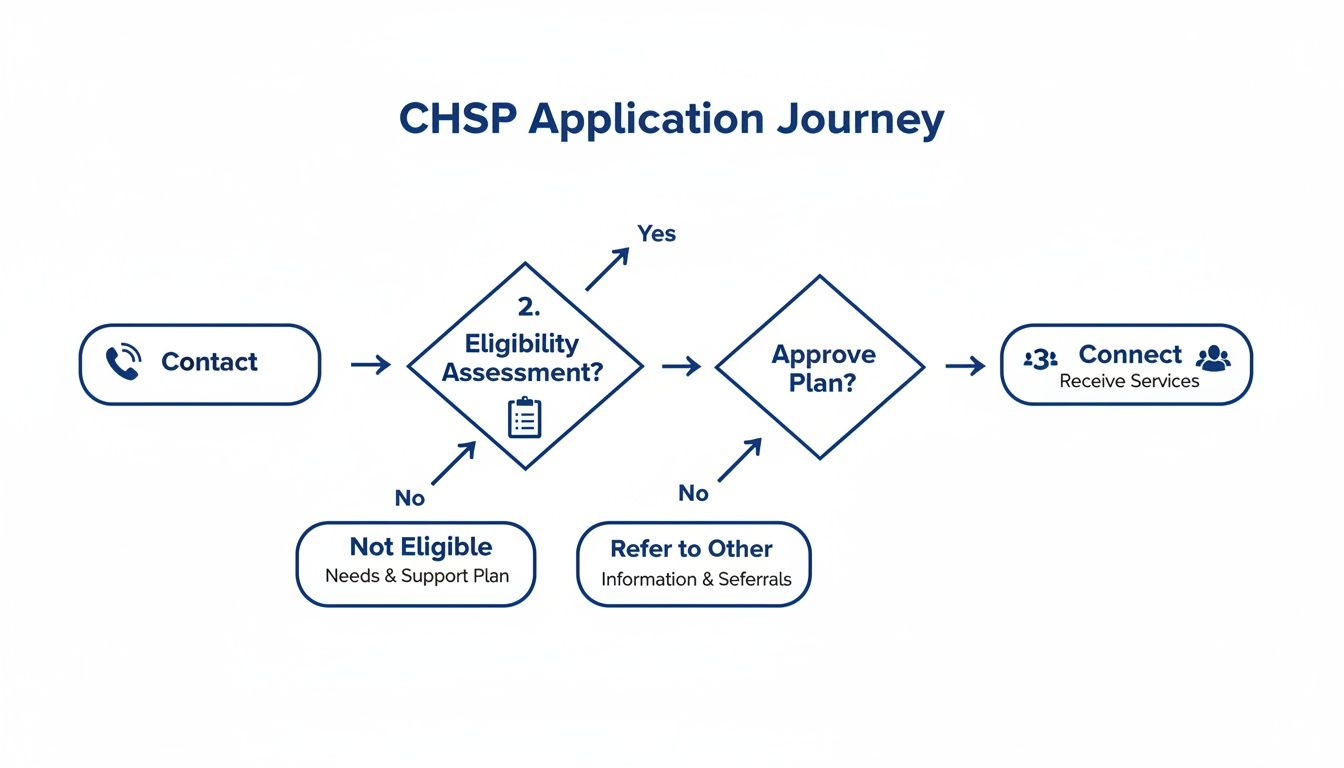
As you can see, the path always begins with contacting My Aged Care. From there, an assessment directs you to the services that match your specific level of need.
How Funding and Management Work
The way these programs are funded also sets them apart. With the CHSP, the government gives subsidies directly to service providers for specific tasks. You might be approved for something like two hours of cleaning a fortnight, and you just pay a small contribution for each service you use.
Home Care Packages work differently. The government gives a budget directly to you, based on your assessed care level. You then choose a provider to help you manage that budget and coordinate all the services you need. This model gives you much more control and flexibility.
It's a good idea to get familiar with how funding works when you're planning for the future. You can learn more about home care services costs to get a clearer picture.
The core takeaway is this: CHSP provides specific services, while a Home Care Package provides a budget for a coordinated package of care. Your assessed needs will decide which path is right for you.
The Future of In-Home Aged Care
The aged care system here in Australia is getting ready for a big, positive change. These upcoming reforms are all about making things simpler and putting the focus squarely on you. While any change can feel a little uncertain, it's really all about giving older Australians more choice and control over the support they get at home.
If you’re currently using the Commonwealth Home Support Programme, the main message is not to worry. Your services are secure. The government is carefully planning the shift to a new, unified system called the Support at Home program, and it's being rolled out gradually to make sure no one is left behind.
The whole point is to create a single, clear system for in-home aged care. Instead of trying to figure out multiple programs, there will be one straightforward pathway. This will make it much easier to find and access the right support when you need it.
What to Expect From the New Support at Home Program
The new Aged Care Act aims to put you firmly in the driver's seat. It’s built around the idea of person-centred care, which means support will be shaped more closely around your individual needs, goals, and what’s important to you. You get a much bigger say in how your support is delivered.
One of the most critical parts of this transition is making sure everything stays stable for current clients. The new Aged Care Act ensures that services will continue as they are, with the program extended to at least 30 June 2027 before it fully transitions to Support at Home. This minimises disruption for over 835,000 people and allows for a smooth, carefully planned rollout. You can explore more about these planned changes to see how the CHSP is evolving.
This new approach is less about fitting you into a service box and more about building a support plan that genuinely reflects your life and what you want to achieve.
How Providers Are Preparing for the Future
Good, quality-focused providers aren't just sitting back and waiting. They're already getting their services in line with this new direction. This means they are focusing more on individual care planning and flexible support, making sure their clients are well-prepared for the new system.
For example, a forward-thinking provider might already be:
- Reviewing Support Plans: Working with clients to ensure their current support is linked to their personal goals, not just a list of tasks. For example, instead of just "transport," the goal becomes "transport to my weekly art class to maintain social connections."
- Enhancing Communication: Keeping families and clients in the loop about the upcoming changes and what they’ll mean in a practical sense.
- Training Staff: Giving support workers the skills to deliver more personalised, goal-focused care.
By taking these steps now, these providers are ensuring the switch to the Support at Home program will feel seamless for the people they support. This preparation guarantees that high-quality, person-centred care will continue without a hitch, both during the changeover and for years to come.
Your Questions About CHSP Answered
It's completely normal to have a few questions when you're looking into the Commonwealth Home Support Programme. Let's walk through some of the most common ones to give you a clearer picture of how it all works.
How Much Do CHSP Services Cost?
The government pays for the bulk of CHSP services, but it’s not entirely free. You’ll be asked to pay a small amount towards the cost of each service you use. This is often called a co-contribution.
It's important to know that each provider sets their own fee, so it can vary. For example, if a group outing costs $50 in total, the government subsidy might cover $35, leaving you to contribute $15. A transport service might charge a flat fee of $10 for a return trip to a medical appointment. If you’re facing financial hardship, speak to your provider, as they can often reduce or even waive this fee.
Can I Choose My Own Service Provider?
Yes, you are absolutely in the driver's seat. Once My Aged Care approves you for services, they will give you referral codes for each type of support. You can then jump on the "Find a Provider" tool on the My Aged Care website to look for accredited providers in your area.
This puts the control back in your hands. You can find an organisation that feels right for you, whether that’s based on their reputation, specific cultural expertise, or how flexible their scheduling is. For instance, you might choose a provider that has support workers who speak your first language.
The power of choice is central to the CHSP. You are not assigned a provider; you actively select the one that feels like the right fit for you and your family.
What Happens If My Needs Increase?
The CHSP is designed for that first level of support. If your needs change and become more complex, it’s not the end of the road. Your current provider can help you ask My Aged Care for a new, more detailed assessment with an Aged Care Assessment Team (ACAT).
For example, if you had a fall and now need daily help with showering and dressing, your CHSP gardening service is no longer enough. An ACAT can determine if you’re eligible for a Home Care Package (HCP), which offers a coordinated bundle of services for more complex, ongoing needs. Your CHSP provider can support you during this transition, making sure you don't have any gaps in care. Knowing all your options, including support like assistance with daily life under the NDIS, is key for long-term peace of mind.
Can I Change Providers If I Am Not Happy?
Of course. If your current provider just isn't the right fit or isn't meeting your expectations, you have every right to switch. You simply let them know you're stopping services and then take your existing referral codes to a new provider you've chosen. For example, if you find your current cleaning service isn't very thorough, you can contact another local provider, give them your referral code, and arrange for them to take over. The best part? You don’t need to go through another assessment to do it.
If you are looking for expert, person-centred in-home nursing and support in the Sydney to Wollondilly region, the dedicated team at Core Nursing Solutions Pty Ltd is here to help. Our registered nurses and trained support workers collaborate with you and your family to deliver high-quality care that respects your independence and dignity. Visit us at https://corenurses.com.au to learn how we can support your health and well-being at home.
Pingback: Your Ultimate Guide to NDIS In Home Care - Core Nursing Solutions
Pingback: Your Ultimate Guide to NDIS In Home Care