

When you’re searching for a service agreement template for your NDIS plan, it’s important to know what you’re really looking for: a document that builds clarity and trust between you and your provider. In other words, think of it as a shared promise. This is to make sure all the supports, prices, and responsibilities are out in the open and agreed upon by both parties.
Why a Clear NDIS Service Agreement Is Essential

Trying to coordinate NDIS funding can feel overwhelming, especially when you’re dealing with high-intensity health supports. A well-written service agreement is much more than just paperwork; it’s the very foundation of a successful and respectful care partnership. It’s what turns your NDIS plan into a practical, day-to-day action plan that everyone is on the same page with.
This document becomes your roadmap, heading off any potential misunderstandings about the services, schedules, and costs down the line. While the NDIS doesn’t always mandate one, a clear agreement is a powerful tool for empowerment.
The Power of Mutual Understanding
At its heart, a service agreement is all about communication. More importantly, it is the formal confirmation that you (the participant) and your provider share the exact same expectations. Because this mutual understanding is absolutely vital for building a strong, trusting relationship where you feel confident your needs will be met consistently and professionally.
This is a collaborative document to negotiate your terms and needs. Likewise, you have every right to discuss, question, and ask for changes to any part of it before signing. Thus, this co-design process is what makes sure the final agreement truly reflects your unique situation, goals, and personal preferences.
Achieving Full Transparency in Your Supports
One of the biggest wins of having a detailed service agreement is total transparency, because it cuts through the jargon and clearly lays out every single aspect of the support you’ll be receiving. Where there’s ambiguity, there’s a risk of stress and disputes, but a transparent agreement gets rid of all the guesswork.
A solid agreement must spell out:
- All services and supports: Every specific task should be listed, from personal care right through to complex clinical procedures.
- Clear pricing: Costs need to be itemised based on the current NDIS Pricing Arrangements and Price Limits, showing hourly rates or per-service costs.
- Number of hours: The agreement should specify the exact amount of support you’ll get, whether it’s daily, weekly, or on an as-needed basis.
- Worker experience levels: For specialised care, the agreement can even define the qualifications or specific experience required for the staff who will be delivering your supports.
By putting everything down in writing, the service agreement becomes the single source of truth. It protects both you and the provider by making sure there are no surprise costs or unmet expectations later on.
A Real-World Scenario: Ventilation Support in Sydney
Let’s imagine a family in Sydney arranging in-home ventilation support for their child. Their needs are complex, requiring highly skilled nursing staff at very specific times. Without a rock-solid agreement, it would be easy for confusion to creep in about a nurse’s qualifications, what happens in an emergency, or the precise hours of overnight care.
Their provider works alongside them to create a detailed service agreement template for NDIS that specifies:
- Hours of Care: 10 hours of overnight nursing care, running from 9 PM to 7 AM, seven nights a week.
- Staff Qualifications: All shifts must be staffed by a Registered Nurse who has certified competency in paediatric ventilation and tracheostomy management.
- Specific Duties: The agreement clearly lists tasks like regular machine checks, suctioning as needed, and documented emergency response procedures.
- Pricing: The cost is transparently broken down per hour, aligning perfectly with the relevant NDIS high-intensity support item number.
This level of detail gives the family incredible peace of mind. In this case, they know exactly what to expect and have a clear document to refer back to.
For anyone trying to get a handle on what’s possible with in-home care, taking a look at a provider’s full list of NDIS nursing services can give you a great idea of what can be included in your own agreement. Similarly, this clarity is the bedrock of a safe and effective support system, empowering families to manage complex health needs at home with total confidence.
What Goes into a Compliant Service Agreement?
A proper NDIS service agreement is so much more than a simple list of services; it’s the blueprint for your care. To ensure everything is above board and, more importantly, to give you peace of mind, this document has to break down every single part of your support system with total clarity. It’s all about creating a shared understanding that protects everyone involved, leaving no room for guesswork.
This agreement becomes the single source of truth for your supports. Therefore, it is a living document that you and your provider create together.
Defining the Scope of Services
First things first, the most critical part of any service agreement is getting the scope of supports crystal clear. Similarly, any fuzziness here can quickly lead to confusion and needs not being met. It’s not good enough to just write down “personal care”; the agreement has to spell out exactly what that means for you.
For example, does it cover help with showering and dressing, or does it also get into more complex jobs like managing your medication? It’s vital to differentiate between the types of support. Understanding the nitty-gritty of personal care support, for instance, makes sure both you and your support worker are on the same page about the duties involved.
A well-defined scope is the best way to manage everyone’s expectations.
- Be Specific About Tasks: List out all the duties clearly, like “help with preparing meals,” “changing complex wound dressings,” or “monitoring overnight ventilation equipment.”
- Set Clear Boundaries: Also make sure to outline what is not included. This stops misunderstandings in their tracks, like a support worker being asked to do something they aren’t qualified or insured for.
- Link Everything to NDIS Goals: Every service listed should tie back to a specific goal in your NDIS plan. This is how you show the supports are reasonable and necessary.
Outlining Roles and Responsibilities
This section helps build a respectful, collaborative relationship by making sure everyone understands their role.
For you, the responsibilities might be things like providing a safe environment for your support staff to work in, letting them know about any changes to your health, or giving timely feedback.
For the provider, the list of responsibilities is naturally longer. As an example, they have to commit to delivering supports safely and respectfully, make sure their staff have the right qualifications, keep communication lines open, and stick to the NDIS Code of Conduct.
Think of this section as the “rules of engagement.” It sets up a framework for how you’ll work together, ensuring that if any issues pop up, there’s a clear and fair process for sorting them out.
Structuring Pricing and Payments Transparently
Let’s talk money. Your service agreement needs to detail every cost with absolute transparency. To emphasize, this part of the document should leave you with zero questions about how your NDIS funding is being spent. It must also stick strictly to the latest NDIS Pricing Arrangements and Price Limits.
Before you start with a provider it’s important to lay out all the essential clauses.
Essential Clauses for Your NDIS Service Agreement
| Clause | Purpose and Key Details |
|---|---|
| Scope of Services | Clearly lists all agreed-upon supports and tasks. It should be specific to avoid any confusion about what is included. |
| Roles & Responsibilities | Outlines the duties of both the participant and the provider, creating mutual understanding and respect. |
| Pricing & Payments | Details all costs, including NDIS line items, hourly rates, and any extra charges like travel. Full transparency is key here. |
| Cancellation Policy | Defines the rules for cancelling a service, including notice periods and any potential fees. It must be fair to both parties. |
| Privacy & Consent | Explains how your personal and health information will be managed, stored, and shared, ensuring your confidentiality is protected. |
| Incident Management | Describes the process for reporting and handling any incidents, accidents, or complaints. This is a mandatory NDIS compliance item. |
| Agreement Review & Changes | Sets out how and when the agreement will be reviewed and updated to make sure it continues to meet your evolving needs. |
Having these clauses clearly defined builds a strong foundation of trust and accountability.
The agreement should break down the pricing like this:
- Itemised Costs: Identifies each service which should be listed with its NDIS line-item number and price.
- Hourly Rates: Clearly state the cost per hour for different times (e.g., standard hours, evenings, weekends).
- Additional Charges: Any other potential costs, like travel for workers or fees for consumables, must be explicitly stated and agreed upon upfront.
- Worker Experience Levels: For high-intensity supports, pricing might change based on the nurse or support worker’s qualifications. This is so you know you’re getting the expertise you’re paying for.
This level of detail gives you the power to manage your budget effectively and means no nasty financial surprises down the line.
Handling Cancellations, Privacy, and Incidents
Some topics are sensitive, and they need clear, fair policies to match. A good service agreement tackles these areas head-on to prevent disputes before they happen.
A fair cancellation policy is a must. It should respect your needs while also acknowledging the provider’s operational realities. For instance, it might say that cancellations with less than 48 hours’ notice could be charged, but it should also have exceptions for unavoidable things like a hospital admission.
Privacy and consent are completely non-negotiable. The agreement has to outline how your personal information will be handled, stored, and shared. As well as including a clause for you to consent to sharing relevant health information with your GP or other specialists to ensure your care is coordinated.
Finally, an incident reporting clause is mandatory for NDIS compliance. It must explain the process for reporting and managing any incidents, making sure your safety and wellbeing are always the number one priority. A review clause must also be included. As a result, this ensures the agreement is updated as your needs change over time.
Tailoring Your Agreement for Complex Nursing Needs
When you’re dealing with high-intensity supports, a generic, one-size-fits-all agreement just won’t cut it. For example, complex nursing care demands a document that’s meticulously detailed with complete transparency. This isn’t just paperwork; it’s about turning a standard document into a precise action plan for your unique health needs, ensuring safety, clarity, and peace of mind for everyone involved.
The secret is to get granular. Move beyond broad service categories and spell out the specific, daily tasks that truly matter. A well-crafted service agreement template for NDIS becomes your most powerful communication tool when it details not just what support is provided, but how, when, and by whom. This is where mutual understanding and absolute transparency are non-negotiable.
To make sure nothing gets missed break the process down into three clear phases.
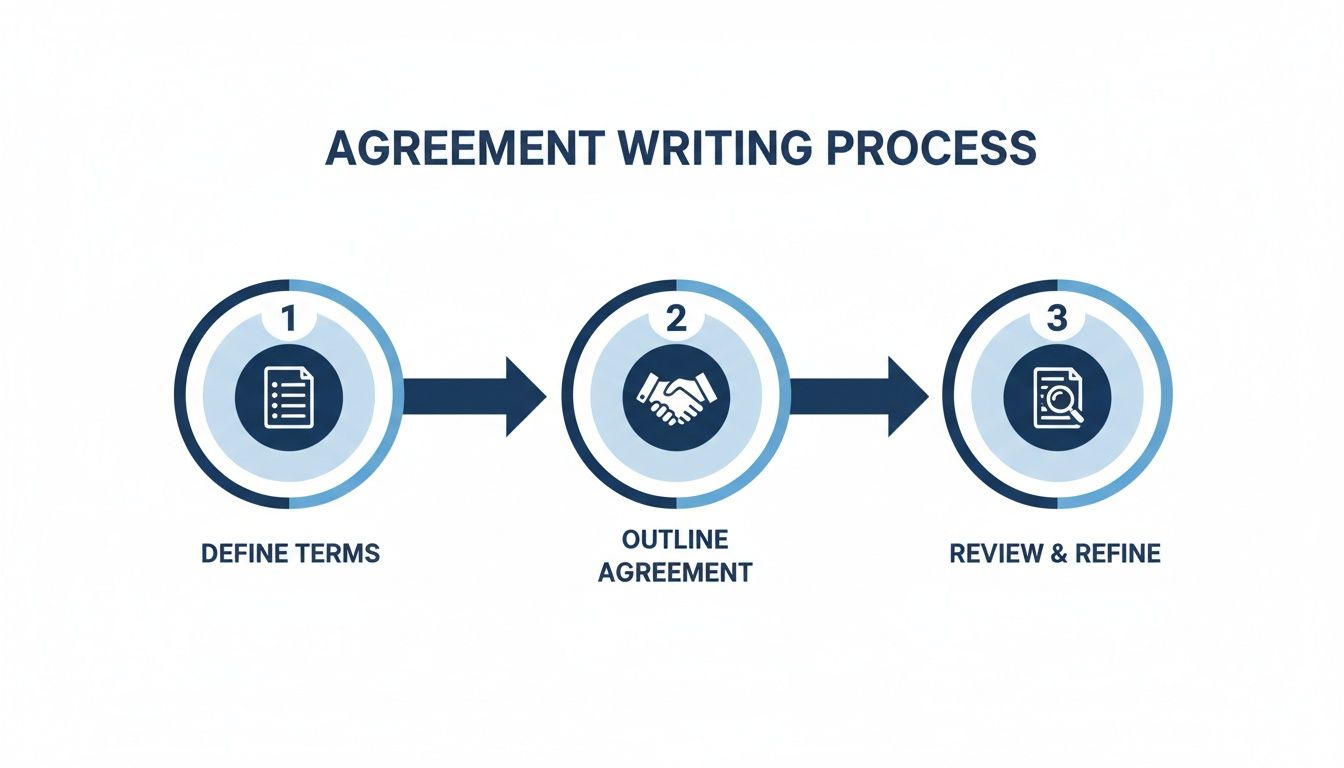
As you can see, a solid agreement always starts with defining your needs, then moves to outlining the specifics, and wraps up with a thorough review. Following this flow helps ensure the final document is comprehensive and something both parties are happy with.
Specifying Tracheostomy and Ventilation Support
For participants who need tracheostomy and ventilation support, the service agreement must act as a detailed clinical protocol. When it comes to life-sustaining equipment, there’s absolutely no room for ambiguity. The document has to clearly outline every single responsibility to guarantee consistent, safe care.
This means getting specific about the required qualifications for support staff. It’s not enough to simply list “nursing support.” Your agreement should explicitly state that care will be provided by a Registered Nurse who holds certified training in tracheostomy management and ventilator operation. Therefore, this ensures the person walking through your door has the exact skills you need.
Here’s a practical example of how you could word this in an agreement:
Support Item: Assistance with High-Intensity Daily Personal Activities (Item No. 01_04_011_01_1)
Description of Support: Overnight ventilation support (NIV) for 8 hours per night, 7 nights a week, from 10 PM to 6 AM.
Worker Competency: All shifts will be staffed by a Registered Nurse with a minimum of 2 years of experience in respiratory support and current competency in NIV management, including machine checks and emergency protocols.
Specific Duties:
- Hourly checks of the ventilator settings and mask fit.
- Regular suctioning as per the participant’s care plan.
- Documentation of observations in the communication log every 2 hours.
Pricing: Billed at the NDIS-approved hourly rate for a Registered Nurse on a weekday evening/night shift.
This level of detail takes all the guesswork out of the equation. It sets a clear standard of care that both you and your provider have agreed on, directly linking the service to the NDIS goal of maintaining health and living safely at home.
Detailing Enteral Feeding Management
When a participant relies on enteral (tube) feeding, the service agreement needs to be just as precise. It should reflect a coordinated approach that involves not only the nurse or support worker but also the participant’s dietitian and other allied health professionals. Think of the agreement as the central document that keeps everyone on the same page.
Clarity around feeding schedules, pump management, and emergency procedures is vital. The agreement should detail the type of feed, the volume, and the frequency to ensure consistency, regardless of which support worker is on shift. It should also outline how you’ll manage communication with the dietitian to handle any changes to the feeding plan.
Here’s how this might look in your agreement:
- Service: Management of Percutaneous Endoscopic Gastrostomy (PEG) feeding.
- Schedule: Administration of prescribed formula via feeding pump at 8 AM, 12 PM, and 6 PM daily, as per the dietitian’s current plan.
- Duties Include:
- Priming the feeding pump and setting the correct rate.
- Flushing the tube before and after each feed.
- Monitoring for signs of intolerance or complications.
- Weekly coordination call with the participant’s dietitian to report progress.
- Costs: The hours are billed under the relevant NDIS support category, with a separate, agreed-upon cost for specific consumables like feeding bags if not supplied elsewhere.
This approach ensures the support is part of a holistic, well-managed clinical plan, not just a series of tasks. In this case, for families navigating these needs, understanding the full scope of complex disability care available can empower them to advocate for more effective and detailed service agreements.
Outlining Complex Wound Care Protocols
Complex wound care requires a clear plan that defines everything from the frequency of dressing changes to the specific products that will be used. A service agreement brings much-needed transparency to this process, especially when it comes to costs. For example, many specialised wound care products can be expensive, and the agreement must clarify how these consumables will be funded and sourced.
The agreement should directly link the wound care regimen to the participant’s NDIS goals, like improving physical wellbeing and preventing hospitalisations. It’s also crucial to specify the qualifications of the nurse performing the care—for example, a Registered Nurse with accredited wound care training.
To give you an idea, here’s a sample table you could include:
| Service Aspect | Details in the Agreement |
|---|---|
| Frequency | Aseptic dressing changes to be performed 3 times per week (Monday, Wednesday, Friday) by a Registered Nurse. |
| Procedure | Includes wound cleansing, application of prescribed antimicrobial dressing, and re-bandaging as per the Stomal Therapist’s plan. |
| Consumables | The cost of specific dressings (e.g., Aquacel Ag) will be billed separately using NDIS line item 03_04_007_01_1. |
| Reporting | A weekly progress photo and report will be sent to the participant’s GP to monitor healing and adjust the care plan as needed. |
By breaking down the costs and procedures this way, the service agreement becomes a tool for both financial clarity and clinical governance. It ensures everyone understands their role and responsibilities, creating a foundation of trust that is essential for managing serious medical needs at home.
How Your Plan Management Choice Affects Your Agreement
Who holds the purse strings for your NDIS funds? This isn’t just an administrative detail; it fundamentally changes how your service agreement works in the real world. Thus, you can see the way your plan is managed. Whether you’re in the driver’s seat, using a plan manager, or are NDIA-managed—sets the rules of engagement.
Getting your head around these differences is the key to creating a document that’s not only compliant but actually practical. Each management style has its own responsibilities and levels of flexibility. Above all, especially when it comes to things like negotiating terms and getting providers paid. A solid service agreement template for NDIS must be tweaked to fit your specific situation to keep things running smoothly.
Self-Managed Participants: Greater Flexibility and Responsibility
If you self-manage your NDIS plan, you have the most control and flexibility over your funding. This freedom is a game-changer, especially when you’re trying to secure highly specialised care. You can agree on a rate that works for both of you.
But with great flexibility comes great responsibility. Even though you don’t have to follow the price caps, a rock-solid service agreement is non-negotiable. It’s your main tool for accountability, creating a clear written record of the agreed-upon terms, costs, and what services will be delivered.
For instance, say you’re organising catheter care in Wollondilly. As a self-managed participant, your agreement would spell out the exact hourly rate you’ve negotiated, the visit schedule, and the nurse’s required qualifications. When the invoice arrives, you pay the provider directly, then claim the funds back through the NDIA portal, using that agreement as proof of the arrangement.
Plan-Managed Participants: The Best of Both Worlds
Plan Managers are a third-party agency to handle the financial side of your plan. They pay your providers from your NDIS funds, which takes the headache of managing invoices completely off your plate.
This route gives you the freedom to work with both registered and unregistered NDIS providers, opening up a much wider pool of options than you’d have with an NDIA-managed plan.
Your service agreement is just as crucial here. Your plan manager will rely on it to confirm that the invoices they receive are accurate and match the supports you’ve agreed to. Think of it as their instruction manual—they use it to check the services, rates, and hours are all legitimate before they release any of your funds.
Going back to that catheter care in Wollondilly, your service agreement would be shared with your plan manager. Your provider sends their bills straight to the manager, who then checks them against the agreement’s terms, processes the payment, and claims the funds from the NDIS. It’s a smart system of checks and balances that protects your budget.
A well-structured agreement is the bridge between you, your provider, and your plan manager. This is due to everyone working from the same script, which is vital for transparent and efficient payment processing.
NDIA-Managed Participants: Sticking to the Rules
If the National Disability Insurance Agency (NDIA) manages your plan directly, you can only use NDIS-registered providers. In this case, your service agreement has to stick rigidly to the official NDIS Pricing Arrangements and Price Limits (PAPL). There’s zero wiggle room for negotiating rates.
This turns the service agreement into a critical compliance document. This is because it must clearly list the specific NDIS line-item numbers for each support and ensure all costs align perfectly with the current price limits. The provider claims payment directly from the NDIA portal, and the agreement is the core document that justifies every one of those claims. This strict framework is why so many providers who work with NDIS provider Sydney participants rely on a strong network to stay on top of ever-changing compliance rules.
As NDIS pricing changes, having a good service agreement template is indispensable for registered providers. For example, the NDIA’s upcoming 2025–26 PAPL, effective 1 July 2025, will introduce a 3.95% price limit increase for some services. These updates affect both NDIA-managed and plan-managed participants, making adaptable templates essential for keeping invoices accurate and compliant. You can dig into the details in the official report on the 2024-25 Annual Pricing Review.
Getting Pricing Right for Financial Peace of Mind

A well-crafted service agreement goes far beyond just listing your supports; it’s the financial bedrock that protects both you and your provider. For instance, it’s the ultimate safeguard against surprise fees and hidden charges, making sure every dollar from your NDIS plan is properly accounted for.
But just as importantly, it helps keep your provider financially stable. This isn’t just their problem—it’s essential for guaranteeing you get consistent, high-quality care over the long haul. When a provider can clearly see the agreed-upon budget, they can plan their resources, roster the right staff, and invest in the training that your care depends on.
The Reality of Provider Financial Pressures
Let’s be honest: many NDIS providers are working with razor-thin margins. Financial sustainability is a huge challenge across the sector, and when providers are struggling, it directly impacts their ability to deliver the reliable services you need. Vague agreements create financial uncertainty, which can easily disrupt the quality of your care.
In the ever-changing world of the NDIS, these agreements are more critical than ever. A recent sector report painted a stark picture, revealing that nearly 50% of NDIS providers reported financial losses in 2024–25. An even more worrying 81% were either just breaking even or operating on minimal surpluses. You can read more about how these insights are shaping service agreements in the new NDIS world.
This is precisely why a transparent service agreement template for NDIS is so valuable. It gives providers the clarity they need to budget accurately, so they can keep offering essential services without cutting corners.
A fair and transparent agreement isn’t just about protecting your budget; it’s about investing in the stability of the support system you rely on. It builds a partnership where both parties are financially secure and can focus on achieving your health goals.
How to Handle Price Changes and Updates
The NDIS is not a set-and-forget system. On the contrary, every year the NDIA reviews the NDIS Pricing Arrangements and Price Limits. Moreover, these updates can affect the cost of your supports, and your agreement needs a clear process for managing them.
A solid agreement will always include a clause that allows for price adjustments in line with official NDIS changes. To clarify, this means your provider can adapt to new pricing without having to renegotiate your entire agreement from scratch. But—and this is key—the process has to be completely transparent.
A Real-World Example of a Price Update
Let’s say the NDIA announces a 4% increase to the price limit for high-intensity nursing supports, starting on 1 July. Your provider can’t just start charging the new rate. They need to communicate this change to you clearly and professionally before it happens.
Here’s what that should look like:
- A Heads-Up: They should get in touch well before 1 July to explain the upcoming NDIS price adjustment and what it means for your services.
- Clear Paperwork: You should receive a simple addendum or variation to your current agreement. This document will clearly show the old rate, the new rate, and the exact date the change kicks in.
- A Budget Chat: A great provider will also take the time to discuss how this affects your overall plan budget. They’ll want to make sure you still have enough funds to cover all your agreed-upon supports for the rest of your plan.
- Your Go-Ahead: You must agree to and sign this variation before the new rates can be charged. This confirms you understand and consent, keeping the trust between you and your provider strong.
This open approach ensures you are always in the driver’s seat of your budget and fully aware of your spending. Exploring the full scope of disability home care services can also give you valuable context when having these important financial discussions.
Common Questions About NDIS Service Agreements
Even with the perfect template, you’re bound to have a few questions. That’s completely normal. Let’s walk through some of the most common queries we hear, so you can feel confident when managing your supports.
What Happens if My Needs Change?
As Life changes happen, your NDIS plan is designed to adapt. Your service agreement is no different. If you find you need to change the type, frequency, or even the intensity of your services, the first step is always to have a conversation with your provider.
This usually leads to a formal ‘variation’ of the agreement. It sounds complex, but it’s really just a simple document that notes the agreed-upon changes. Both you and your provider sign it, and it gets attached to the original agreement. This keeps everything clear, documented, and transparent for everyone involved.
Can I Be Charged for Something Not Listed in the Agreement?
Absolutely not. This is one of the most important protections your service agreement provides. You cannot be charged for any service or item that isn’t explicitly listed and agreed upon in your signed service agreement template for NDIS.
Any potential costs, from the services themselves, to travel or consumables must be detailed upfront. Therefore, this document is your defense against surprise invoices and ensures you maintain complete control over how your NDIS funds are used.
Think of your service agreement as your financial safeguard. It locks in all charges, ensuring they are pre-approved and mutually understood. No more surprise fees, just a transparent partnership.
How Often Should We Review the Agreement?
It’s good practice to sit down and formally review your service agreement at least once a year. But a review should also happen any time there’s a significant shift in your circumstances.
Good triggers for a review include:
- Receiving a new NDIS plan.
- A major change in your health needs or personal goals.
- Wanting to add or remove a particular support service.
Is This Agreement Legally Binding?
While it’s not a formal court document, an NDIS service agreement is definitely a binding agreement. It is important to know, it falls under the principles of Australian Consumer Law, which protects you from unfair terms and holds providers accountable for delivering what they promise.
It’s a critical piece of your provider’s obligations under the NDIS framework, making it an essential tool for clarity and accountability. It’s the document that ensures everyone is on the same page.
At Core Nursing Solutions Pty Ltd, we believe a clear service agreement is the foundation of a trusting care partnership. If you need complex in-home nursing support delivered with transparency and professionalism, we’re here to help. Find out how we can support you by visiting us at https://corenurses.com.au.
Pingback: A Guide to Independent Living Centres in Sydney - Core Nursing Solutions
Pingback: NDIS Reportable Incident: Keeping Your Care Safe & Compliant
Pingback: Assistance with Daily Life NDIS: Your Complete Guide