
An independent living centre is a unique housing option that expertly blends personal freedom with easily accessible support. Think of it as your own private home nestled within a supportive community, perfect for people who manage their own day-to-day lives but might need some specialised care from time to time. For example, a person living in one of these centres could manage their own shopping and social life but arrange for a nurse to visit twice a week for complex wound care. This approach gives NDIS participants total control over their home while still having a safety net close by.
Understanding Independent Living Centres
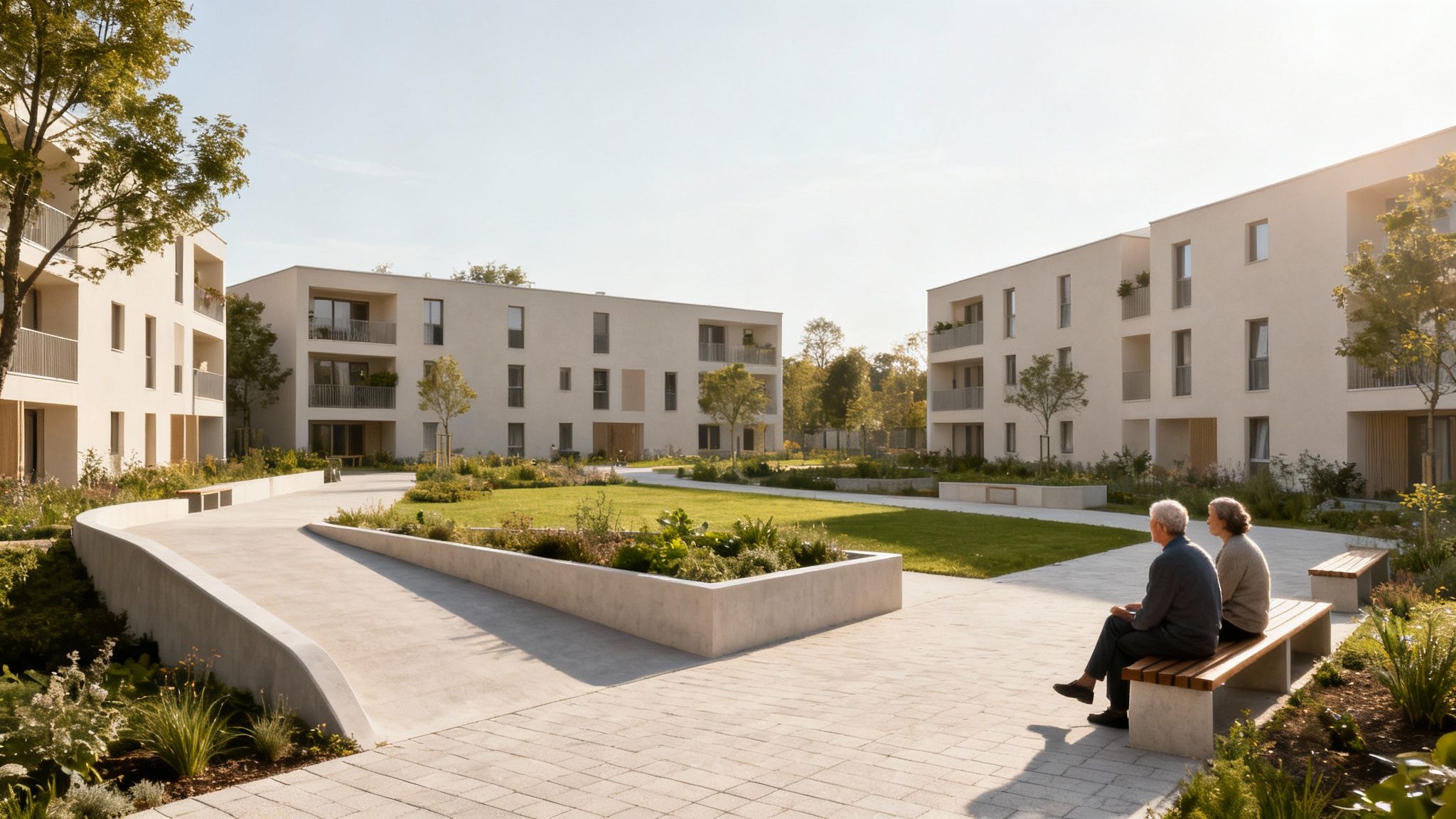
It’s best to think of independent living centres not as facilities, but as thoughtfully designed neighbourhoods. They are residential communities, usually made up of private apartments or units, where individuals or couples can live with complete self-reliance.
The whole idea is to provide the 'hardware' of a home—a secure, accessible, and well-maintained space. You, the resident, then bring in your own personalised 'software' of support services as you see fit. For instance, the centre ensures the building has ramp access and grab rails, while you decide whether to hire an occupational therapist to further adapt your bathroom or a support worker for meal preparation.
This is a huge step away from the old, institutionalised way of living that often grouped people with disabilities away from the wider community. The modern independent living movement is all about self-determination. It recognises that having a disability is just a natural part of the human experience, not something that should take away a person's right to choose their own path.
Key Features Of This Model
At their heart, these centres provide a solid foundation for a self-directed life. Residents have full control over their own space, from what they cook and how they clean to setting their own daily schedule. The centre’s management typically looks after things like external maintenance, gardening, and keeping communal areas tidy, which frees residents up from those jobs.
Here are a few key characteristics you’ll find:
- Private Accommodation: Every resident gets their own apartment or unit, complete with a private kitchen, bathroom, and living areas. This means you can cook your favourite meals whenever you want or have family stay over, just like in any other private home.
- Community and Social Spaces: Many centres have shared amenities like gardens, activity rooms, or lounges, which helps build social connections among residents. A practical example would be a resident-organised weekly card game in the common room or a communal BBQ on a sunny afternoon.
- Separation of Housing and Care: This is the most crucial part. Your accommodation and your support services are completely separate. You choose your home first, and then you arrange your own care providers.
For example, someone living in an independent living centre in Sydney might handle their own shopping and social life but arrange for a registered nurse from a provider like Core Nursing Solutions to visit for daily medication management or complex wound care. This separation gives them the freedom to pick a care team that truly understands their specific health needs and personal preferences.
This model is built on the simple principle that people with disabilities are the true experts on their own needs. It empowers them to design their own services, advocate for their rights, and make the final call on decisions about their lives.
How Independent Living Centres Actually Work
So, how do these centres work in practice? The easiest way to think about it is like renting your own apartment in a well-run complex, but with a built-in community and accessibility features. You get your own front door, your own kitchen, and your own space to call home.
The centre’s management takes care of the big-ticket items—things like property maintenance, building security, and looking after the shared gardens or activity rooms. For instance, if a pipe bursts in your apartment, you call the building manager to fix it, just like in a standard rental. This setup frees you from the stress of home ownership and makes sure your environment is safe and properly maintained. It’s a housing model, first and foremost.
But here’s the most important part: your personal and medical care aren't bundled in. This isn’t an all-inclusive facility. Instead, you have the freedom to choose and organise these services yourself, building a support system that works just for you.
You're in the Driver's Seat
This model puts you firmly in control of your home life and your healthcare. The whole idea is to separate your housing from your support services, giving you complete flexibility.
Let's imagine someone with stable but complex care needs living in their independent living apartment. They handle their own daily life, from cooking meals to catching up with neighbours, but use their NDIS funding for specific clinical support. They might arrange for a registered nurse from Core Nursing Solutions to pop in for skilled tasks, such as:
- Administering specialised injections
- Managing a complex wound
- Changing and monitoring a catheter
This way, they get top-tier medical attention without giving up the independence that comes with living in their own home. You can get a clearer picture of how these arrangements are documented by looking at a typical NDIS service agreement template.
This model is a world away from traditional institutional care. It’s built on the belief that people with disabilities have the right to live in their own homes, make their own choices, and be a part of their community.
A Long History of Independence
The idea of independent living isn't new in Australia; it’s been evolving for decades. Independent Living Units (ILUs) actually trace back to the mid-20th century and have long been a cornerstone of community housing that champions autonomy.
Between 1954 and 1986, the Commonwealth subsidised almost 33,000 ILUs under the Aged Persons’ Homes Act, with a real boom between 1966 and 1975. This history shows a long-standing commitment to helping people live self-directed lives.
And this legacy lines up perfectly with what people want today. Recent data reveals a massive 283% explosion in the use of home care services, while permanent residential care has only grown by 6.3%. It's a clear signal that people overwhelmingly prefer to receive support at home—which is exactly what independent living centres are designed for.
Comparing Your Housing and Support Options
Navigating the world of disability and aged care support can feel like you're trying to solve a puzzle with pieces that all look the same. To make a confident choice, it's so important to understand the unique roles of Independent Living Centres (ILCs), Supported Independent Living (SIL), and Residential Aged Care. Each model strikes a different balance between housing, support, and your own autonomy.
At its heart, an ILC is a housing solution. Think of it as having your own private apartment within a supportive community. Your rent or purchase price covers your home, but you're in the driver's seat, arranging and paying for your personal and clinical supports separately. A practical example is paying your monthly rent to the ILC management, while separately paying an invoice from your chosen nursing provider using your NDIS funds.
SIL, on the other hand, isn't a type of housing at all—it's a support package funded by the NDIS. It's designed to cover assistance with daily tasks so you can live as independently as possible. This support might be delivered in your own home, a private rental, or often in a shared house with other NDIS participants.
The Core Differences Unpacked
Residential Aged Care is the all-in-one model. It bundles your accommodation, personal care, meals, and 24/7 nursing support into a single package. This integrated approach is built for people, usually older Australians, who have high and ongoing care needs that call for constant supervision and help.
The real difference comes down to control. With an ILC, you are the master of your domain. You choose your home and then hand-pick your support providers to suit your needs. With SIL, the focus is on the support services you receive, which are often shared among housemates. Aged care provides a complete, structured environment where most services are managed for you.
This diagram helps clarify things by showing how an ILC separates the housing from the resident and their chosen supports.
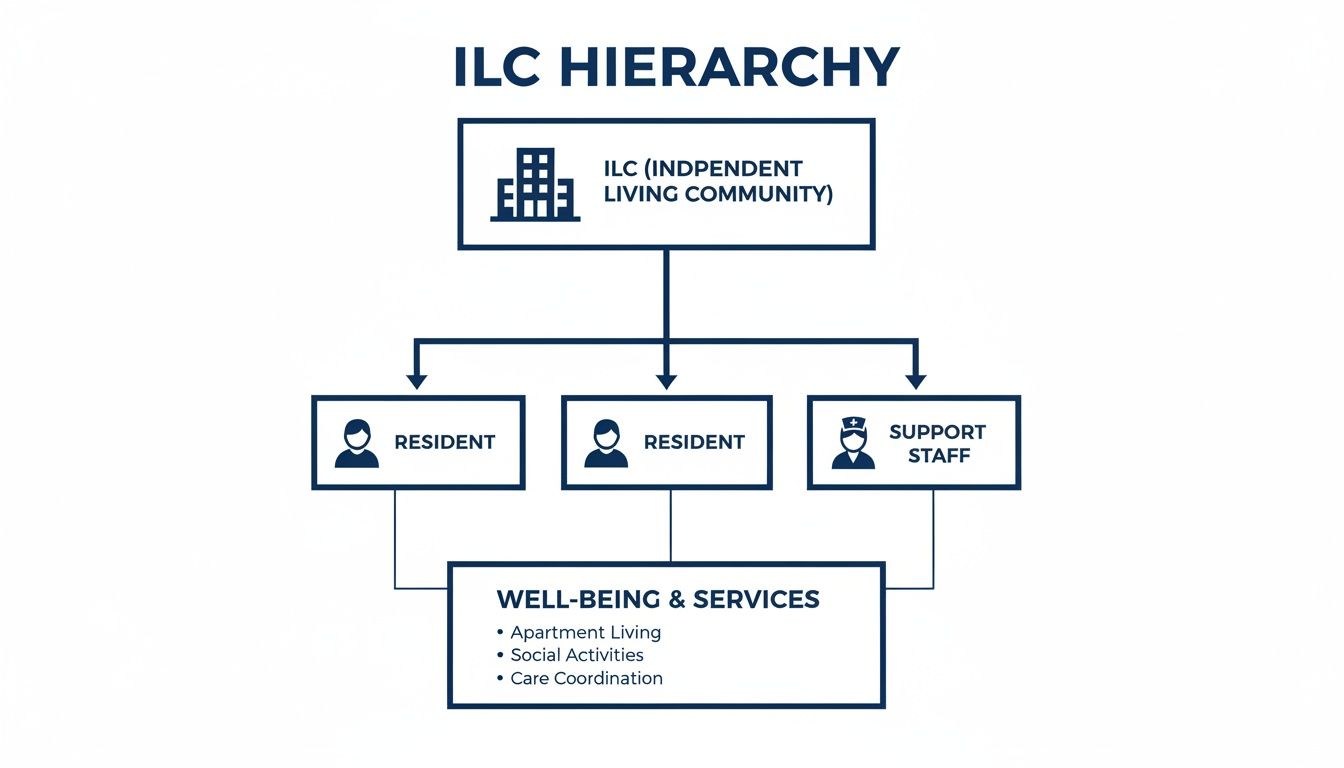
As you can see, the ILC provides the physical home, but it's the resident who independently brings in their own support team, like one of our specialised nurses from Core Nursing Solutions.
Independent Living vs SIL vs Aged Care at a Glance
To make it even clearer, let's break down the key differences in a simple table. This will help you see which option might be the best fit for you or your loved one.
| Feature | Independent Living Centre (ILC) | Supported Independent Living (SIL) | Residential Aged Care |
|---|---|---|---|
| Primary Focus | Housing & community | Personal & daily support | 24/7 comprehensive care & accommodation |
| Accommodation | Private apartment/unit (rent or own) | Varies (own home, private rental, shared) | Private or shared room in a facility |
| Support Services | Chosen & funded separately by the resident | Funded by NDIS, often shared with housemates | Bundled with accommodation, provided by facility |
| Level of Independence | High – resident manages their own life | Moderate to high – support for independence | Low – structured care environment |
| Who It's For | People who want independence with access to chosen supports | NDIS participants needing help with daily tasks | People with high, ongoing care needs |
| Control | Resident has full control over home & supports | Shared control over supports in a group setting | Facility manages care, meals, & environment |
Ultimately, the best choice depends entirely on your personal needs, goals, and how much control you want to have over your daily life and care.
Real-World Examples
Sometimes, seeing how things work in practice makes all the difference. Let's look at a few scenarios.
Independent Living Centre Example: Sarah lives with a chronic respiratory condition in her own ILC apartment in Wollondilly. While she manages her day-to-day life, she uses her NDIS funding to have a Core Nursing Solutions nurse visit for ventilation support and tracheostomy care. She has complete control over her home and her clinical team.
Supported Independent Living Example: Ben lives in a shared SIL home with two other NDIS participants. A support worker is on-site for several hours each day to help all three residents with meal prep, cleaning, and personal care tasks according to a roster. The support is shared, and the living arrangement is communal.
Residential Aged Care Example: Arthur has advanced dementia and needs round-the-clock supervision and nursing care. He lives in a residential aged care facility where staff manage his medication, meals, and personal care in a secure, fully serviced environment.
These support models are always evolving. For example, Independent Community Living Australia (ICLA) shows the real-world impact of specialised living arrangements. In their 2021–2022 report, ICLA supported 35 people in SIL properties with 24/7 assistance, demonstrating a deep commitment to high-needs groups—with 82% of them identifying as experiencing schizophrenia. This dedication to specialised care is exactly what in-home providers do for clients with complex health needs.
Choosing the right model really means matching the level of support you need with how much independence you want. An ILC offers the highest degree of autonomy, making it an ideal choice for those who can manage their daily lives but need specific, high-level clinical care brought directly to them.
In the end, understanding the costs associated with home care services is crucial when you're planning your supports within an ILC. This knowledge empowers you to budget effectively and make the most of your NDIS plan.
Using Your NDIS Plan to Fund Your Supports
So, let's get down to the practical side of things—funding your life in an independent living centre. A question we hear all the time is whether the NDIS pays for the accommodation itself. The short answer is no. Typically, the NDIS doesn't cover rent, board, or other day-to-day housing costs.
Your NDIS plan, however, is designed to fund the supports you need to live there successfully. Think of it like this: you handle the "roof over your head," and the NDIS funds the "reasonable and necessary" services that help you thrive under it.
This clear separation is what gives you genuine control and choice over both your home and your care.
How Different Budgets Work for You
Your NDIS plan is broken down into different budgets, and each has a specific job. You can draw from them to build a support network that fits your life perfectly in an independent living centre.
Here’s a look at how it works in practice:
- Core Supports Budget: This is your most flexible budget, meant for your daily living assistance. For example, you could use these funds to pay a support worker for three hours each morning to help with showering, dressing, and preparing breakfast.
- Capacity Building Budget: This budget is all about helping you build skills and independence. For instance, you could fund occupational therapy to assess your apartment and recommend assistive technology like a shower chair, or use it for sessions with a physiotherapist to improve your mobility.
For participants with complex medical needs, this funding becomes even more specific and essential.
The core principle of NDIS funding in this context is empowerment. It funds the person, not the place. This ensures you can access the specialised care you need, no matter which independent living centre you choose as your home.
Funding High-Intensity Clinical Care
This is where the model really makes a difference for people with significant health needs. Your NDIS plan can fund high-intensity daily personal activities, which covers the advanced, clinical care you need to manage your health safely at home.
This means you can use your NDIS funding to bring in a specialised provider like Core Nursing Solutions for essential, nurse-led care. It allows you to live with dignity and autonomy in your own apartment while still receiving high-level medical support.
For example, your plan could fund a registered nurse to provide:
- Tracheostomy Management: Regular, skilled care to make sure your airway is safe and healthy.
- Ventilation Support: Assistance with BiPAP or CPAP machines to manage respiratory conditions.
- Complex Wound Care: Professional dressing changes and monitoring to prevent infection and help with healing.
- Enteral Feeding Support: Managing PEG tubes and feeding schedules with clinical precision.
This ability to direct funding towards expert nursing care is what makes independent living a real and empowering option for so many. It bridges the gap between wanting independence and needing complex health support.
Understanding what your plan can cover is a great first step. To see a detailed breakdown, you can learn more about how NDIS funding assists with daily life activities. By using your plan strategically, you can create a safe, supportive, and self-directed life in the independent living centre of your choice.
Choosing The Right Centre In Sydney And Wollondilly
Finding an independent living centre that truly feels like home involves more than ticking features off a list. You’re aiming for a blend of personal freedom and expert support. In Sydney and Wollondilly, that means weighing up location, community spirit and, most importantly, whether your NDIS provider can deliver the care you need.
Everyone’s priorities differ. Rather than chasing “the perfect” centre, focus on the one that matches your day-to-day rhythm and health requirements.
Your Actionable Search Checklist
It’s easy to be dazzled by manicured gardens or grand lounges. To keep your eyes on what really counts for long-term independence, ask:
- Location and Accessibility: Is the centre near family, friends or essential services such as your GP or local shops? Are pathways, entrances and units genuinely wheelchair-friendly? A practical check would be to see if there are step-free paths from the car park to your potential front door.
- Community Atmosphere: Does the place feel welcoming? Chat to current residents to gauge whether the social vibe suits you. For example, you could ask them if there are regular social gatherings or if people tend to keep to themselves.
- External Provider Policy: This is non-negotiable. Ask, “Can registered nurses or other NDIS-funded providers visit residents?” and get that answer in writing. A good follow-up question is, "Is there a specific check-in process for visiting health professionals?"
“A true independent living centre should be a launchpad for your ambitions, not a hurdle. The right place embraces your chosen care team.”
Case Study: David’s Journey To Independence
David, an NDIS participant with complex respiratory needs, wanted his own apartment plus daily ventilation support from Core Nursing Solutions. His shortlist in Wollondilly included three centres:
- A modern facility boasting great amenities but a vague external-provider policy.
- A warm, friendly community too far from David’s existing social network.
- A centre that ticked every box—management confirmed Core Nursing Solutions could visit, discussed nurse access routes and guaranteed backup power for his equipment.
David moved into the third centre because it balanced his health needs with the chance to stay connected and active.
The Growing Demand For Independent Living
David’s experience reflects a wider shift. The 2016 Census recorded about 170,700 ILUs across Australia, and NSW led the pack by adding 14,420 new units between 2011 and 2016—a 27% surge. At the same time, home care usage has leapt by 283%, underlining how many people prefer quality support in their own space.
By doing your homework and asking the right questions, you’ll find an independent living centre that lets you live on your terms. For guidance on aligning in-centre living with in-home nursing, see our guide on home care services in Sydney.
Integrating In-Home Nursing for True Independence

This is where your power of choice really comes to life. An independent living centre gives you the perfect foundation—a safe, accessible home designed for you to live on your own terms. Then, a specialised provider like Core Nursing Solutions brings the clinical care you need right to your door.
You can think of it like this: the centre is the stable 'hardware' of your home. Your in-home nursing support is the personalised 'software' that runs seamlessly within it, tailored exactly to your health needs.
This integrated approach means you never have to compromise. You get to keep your independence and lifestyle without giving up the high-quality, evidence-based care that's essential for your wellbeing.
Seamless Care Coordination
One of the biggest advantages of this model is how it organises your healthcare. Your in-home nursing team becomes your central point of contact, coordinating everything with your GP, specialists, and other allied health professionals. This teamwork ensures everyone is on the same page, creating a strong, cohesive support system around you.
This collaborative approach is vital, especially when you're managing complex conditions. For example, your registered nurse can give your doctor accurate, real-time updates on things like wound healing or blood pressure readings, which allows for quick adjustments to your treatment plan without you needing to travel to the clinic.
This model empowers NDIS participants in Sydney and Wollondilly to reject the false choice between autonomy and complex care. It proves you can have both, creating a new, more self-directed way to live on your own terms.
Practical Examples of Integrated Support
Blending specialised housing with clinical care opens up possibilities that might otherwise seem out of reach. It’s all about building a life that’s defined by what you can do, not by disability.
Here’s how it works in the real world:
- Post-Hospital Recovery: After a hospital stay, you can come back to your own apartment in an independent living centre. A nurse can visit to manage surgical wounds, give injections, and monitor your recovery, helping prevent any complications.
- Chronic Condition Management: Someone with a long-term respiratory illness can live independently, knowing that a nurse will be there to provide regular ventilation support and tracheostomy care.
- Progressive Needs Support: For people with conditions that might change over time, this model is incredibly flexible. For instance, if a person's mobility decreases, we can easily increase support from one visit per week to daily visits, all without the disruption of having to move.
Ultimately, this partnership between your home and your healthcare team creates a solid safety net. It allows you to receive high-quality disability home care services in the comfort and privacy of your own space, securing both your health and your independence.
Frequently Asked Questions
Figuring out your support and housing options can feel like a puzzle. Here are some clear, straightforward answers to the questions we hear most often about independent living centres.
Can I Use NDIS Funding to Pay for Rent?
No, the NDIS doesn't cover rent or other general living costs. Your NDIS plan is there to fund the "reasonable and necessary" supports you need to live independently, not the bricks and mortar of your home.
For instance, you'd pay your rent privately, but you can absolutely use your NDIS funding for a registered nurse from Core Nursing Solutions to visit your apartment. We can help with essential clinical tasks like tracheostomy care or managing a complex medication schedule, right where you live.
The NDIS funds the person, not the place. This is a key principle. It gives you the freedom to choose where you want to live while making sure you still get the critical supports you need to be well and safe there.
What Is the Main Difference Between an ILC and a Nursing Home?
The biggest difference comes down to the separation of your housing from your care. In an independent living centre, you have your own private apartment that you rent or own, and you arrange your support services separately. This puts you in the driver's seat. For example, in an ILC, you decide if you want a cleaner once a week, whereas in a nursing home, cleaning services are part of a fixed schedule.
A nursing home, also known as a residential aged care facility, offers an all-in-one package. It bundles your accommodation, meals, personal care, and 24/7 nursing support together. It’s a much more structured environment, usually for people who have very high and constant care needs.
Are There Staff On-Site 24/7 in Independent Living Centres?
It really varies from one centre to another. Some might have an on-site manager or security guard during business hours, while others may just provide a 24/7 emergency call system for urgent situations, like a pull-cord in the bathroom that connects to an external monitoring service.
However, it’s not standard for independent living centres to have round-the-clock nursing or personal care staff on standby for everyone. If you need 24/7 clinical support, you would organise and fund that yourself through your NDIS plan. This allows you to choose a dedicated provider who understands your specific needs.
At Core Nursing Solutions Pty Ltd, we partner with NDIS participants in independent living centres across Sydney and Wollondilly. We deliver expert, in-home clinical care that supports your health goals and your independence. Find out how our registered nurses can help you live confidently on your own terms by visiting us at https://corenurses.com.au.
Pingback: Your Guide to the Commonwealth Home Support Program - Core Nursing Solutions
Pingback: Living Independently with a Disability: A Practical Guide for Sydney Residents - Core Nursing Solutions
Pingback: A Guide to Independent Living for Disabled People in Sydney - Core Nursing Solutions