
When people hear the term "independent living," it often conjures up an image of someone doing everything completely on their own. But for people with disabilities, that’s a common and unhelpful misconception. True independence isn’t about solitude; it’s about having choice and control to live your life on your own terms.
It’s about having the right support network in place—whether that’s family, assistive technology, or a skilled nurse—so you can direct your own life with dignity. For example, independence might mean being able to choose your own support worker who assists with your morning routine, rather than having to adapt to a facility’s rigid schedule.
Redefining What Independent Living Really Means
For too long, the idea of independence has been tangled up with doing everything by yourself. This outdated view creates a false barrier, suggesting that needing a hand somehow makes a person less autonomous. But the modern approach to independent living for disabled people completely flips that idea on its head.
Think of it this way: you are the director of your own life. You get to write the script, choose the setting, and decide who gets the supporting roles. The focus shifts from what a person can't do to what they can achieve when they have the right tools and team around them.
The Core Pillars of Modern Independence
Real autonomy is built on having genuine choice and control over every part of your life. This covers the big decisions and the small ones—from what time you get up in the morning to your long-term health and housing goals. It's about having the power to shape your own world.
This renewed approach is built on a few key ideas:
- Choice: The freedom to decide where you live, who you live with, and how you fill your days. A practical example is choosing to live in an apartment near your university campus instead of a group home further away.
- Control: The power to have the final say on your support plans, daily routines, and the people who assist you. For instance, deciding that you prefer a support worker to help with meal prep in the evening so you can cook dinner yourself.
- Dignity: Getting support that respects your privacy, preferences, and personal goals, helping you live a meaningful life. This could be as simple as having a support worker who knocks before entering your room, respecting your personal space.
This model sees support not as a crutch, but as a tool for empowerment. It’s no different from a CEO hiring an accountant to manage finances. They aren't less in control of their business; they're strategically using expertise to achieve their goals. In the same way, using in-home nursing or personal care services can enhance your ability to run your own life, your way.
Independent living means having the right to make your own decisions. It also means having access to person-centred supports that honour those choices. It’s about truly living in the community, not just being placed there.
Today, systems like the National Disability Insurance Scheme (NDIS) are specifically designed to fund this vision. Specialised providers, like Core Nursing Solutions, are a key part of this ecosystem. By delivering the complex clinical care people need to manage their health safely at home, they help turn the goal of independent living into a daily reality for individuals across Sydney and Wollondilly.
Building Your Foundation with NDIS Living Supports
The National Disability Insurance Scheme (NDIS) is the key to unlocking independent living for many Australians with a disability, but figuring out the funding can feel like trying to solve a puzzle. At its core, the NDIS is designed to give you the resources to build a life on your own terms. Two of the most common pathways for this are Supported Independent Living (SIL) and Individualised Living Options (ILO).
Let's use a travel analogy to make sense of it.
Think of SIL as a well-planned group tour. You share supports with a few other people in the same home, following a fairly structured routine for things like personal care, help with meals, and overnight assistance. It's a fantastic option for anyone who needs a high level of support, often 24/7, within a shared and supportive environment.
ILO, on the other hand, is like getting a travel agent to create a completely custom itinerary just for you. It’s a flexible funding package built around your life and your goals. Instead of fitting into an existing setup, you get to design a unique mix of formal and informal supports that work for you.
Choosing Your Path: SIL vs ILO
So, which one is right for you? There’s no single correct answer. The best choice comes down to your personal needs, what you want to achieve, and what your ideal day-to-day life looks like. Getting to grips with the fundamental differences is the first step.
Here’s a simple breakdown of how each model works in practice:
- Supported Independent Living (SIL): This funding is purely for the support services you get, not for the rent or the building itself. It’s typically used in shared homes with two to seven NDIS participants, where support workers are rostered on to assist everyone. For example, in a SIL home, one support worker might help two residents with their morning routines between 7 am and 9 am.
- Individualised Living Options (ILO): This is a package of funding you use to explore, design, and set up the living arrangement that suits you best. It might involve a support worker dropping in, a housemate providing some help, or even using smart technology—all coordinated around your schedule and what you prefer. For instance, an ILO package could fund a support worker for three hours a day and also contribute to the rent of a housemate who provides overnight on-call support.
The decision tree below helps visualise how the core principles of independent living—control, choice, and dignity—shape these support pathways.
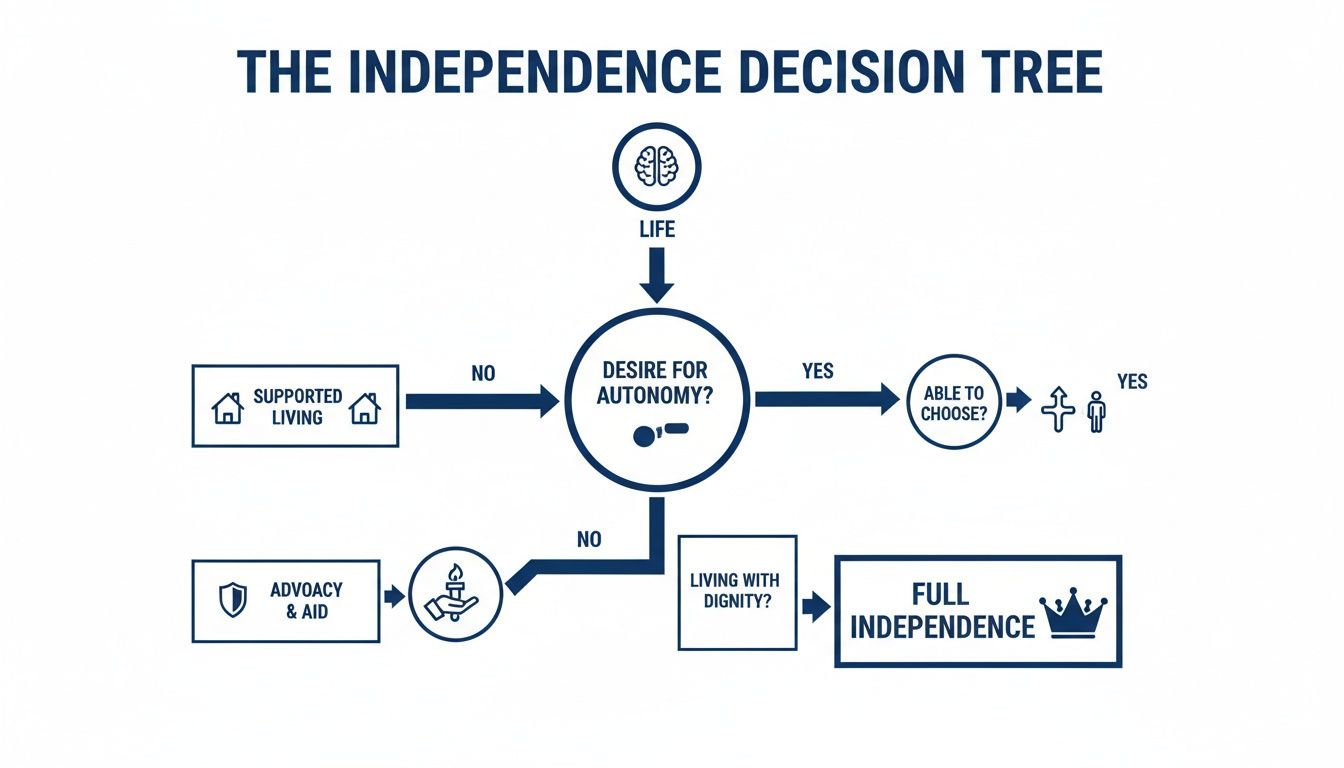
This visual really drives home the point: whether you opt for a structured or a highly flexible support model, the ultimate aim is to put you in the driver's seat of your own life.
A Practical Example in Action
Let’s imagine a young adult named Alex who has cerebral palsy and is ready to move into their own apartment.
Under a SIL arrangement, Alex might move into a purpose-built apartment complex with a few other NDIS participants. Support workers would be onsite 24/7, available to help Alex with their morning routine, meal prep, and any overnight needs, working from a shared roster that covers all the residents.
With an ILO package, the picture looks quite different. Alex could rent a standard apartment in their chosen neighbourhood. Their funding might pay for a support worker to visit for a few hours each morning and evening. It could also help cover a housemate who provides some informal support in exchange for lower rent, creating a much more personalised and flexible setup.
Integrating Essential Clinical Care
For many people, living independently isn't just about daily tasks; it’s also about managing complex health needs safely at home. This is where specialised clinical support, like in-home nursing, becomes absolutely vital. Alex, for instance, might need a registered nurse to manage their medications or provide regular catheter care.
This kind of skilled medical support fits perfectly into both SIL and ILO plans. The NDIS funds these clinical services separately to make sure your health is in the hands of qualified professionals. This allows your support workers to focus on helping you with daily living.
This integrated approach is more important than ever. With demand for SIL surging, its costs have shot up by 28% recently. While 90% of providers offer SIL, reports show the system is under strain, with over 43,500 participants having high support needs. Blending expert NDIS in-home care into your plan is a key strategy for making these living arrangements successful and sustainable for the long haul.
Finding the Right Home with Specialist Disability Accommodation
A home should be more than just four walls and a roof—it’s the foundation for living the life you choose. For many people with significant disabilities, a standard house or apartment just doesn't work. The doorways are too narrow, the benchtops are too high, and the layout creates more problems than it solves.
This is exactly why Specialist Disability Accommodation (SDA) exists. It’s a specific kind of NDIS funding for homes that have high-level accessibility built right into their DNA.
Think of it this way: a typical rental is like buying a suit off the rack. It might do the job, but it rarely fits perfectly. SDA, on the other hand, is like getting a suit custom-tailored. It’s designed around your specific needs, allowing you to move through your own home with real comfort and ease.
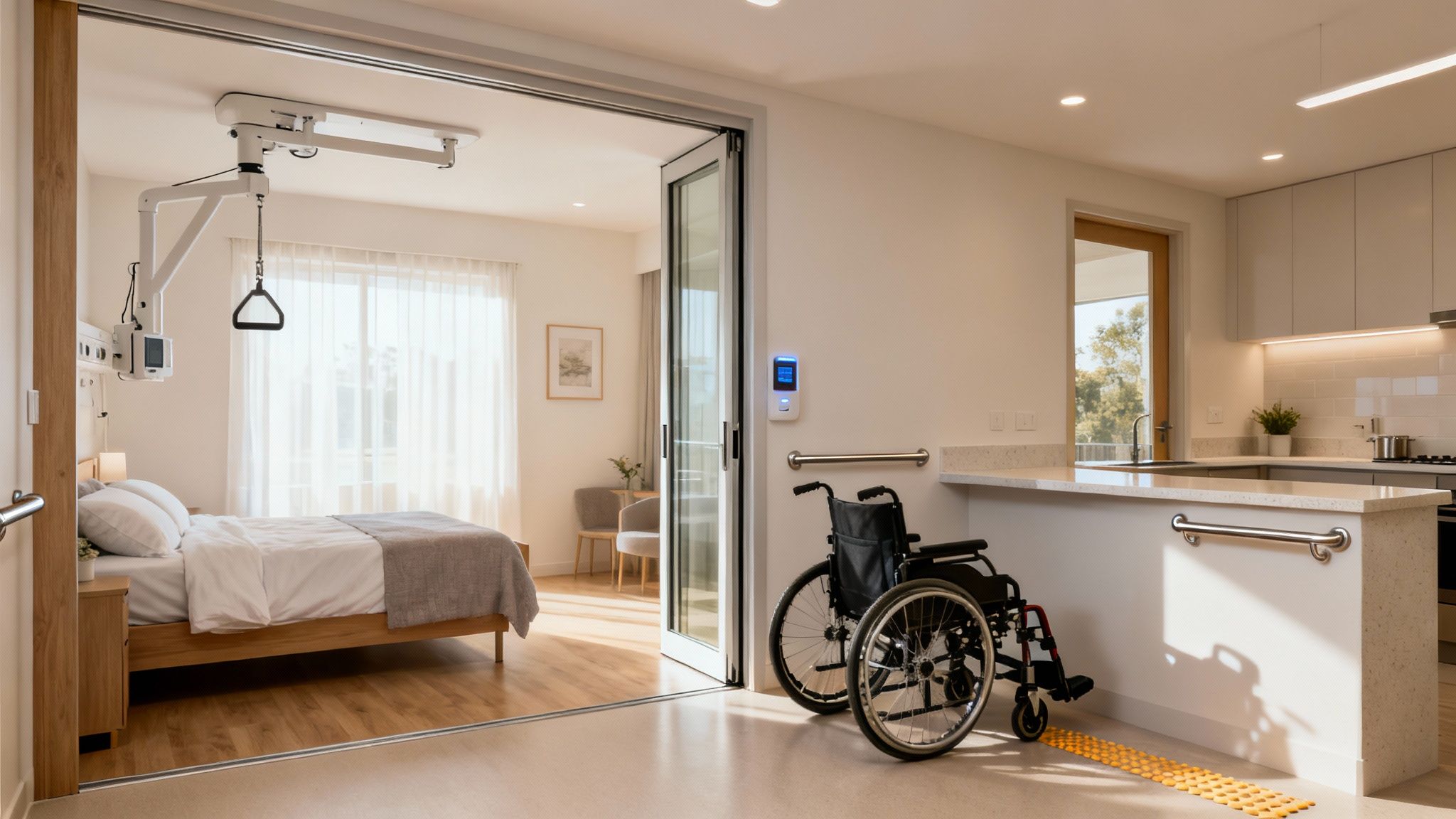
Understanding SDA Design Categories
SDA isn't a one-size-fits-all solution. The NDIS has laid out specific design categories to make sure the home’s physical features are a great match for the person living in it. Each category builds on the last, adding more accessibility features as the support needs increase.
Here’s a quick rundown with practical examples:
- Improved Liveability: This design is geared towards helping people with sensory, intellectual, or cognitive impairments. You’ll see practical features like walls and floors that are easy to see, clear lines of sight, and simple layouts that help reduce confusion. For example, kitchen cupboards might have picture labels, and light switches will be placed at a consistent, logical height throughout the home.
- Fully Accessible: These homes are built from the ground up to support people with significant physical challenges. Think no steps, extra-wide doorways for wheelchair access, and bathrooms and kitchens designed to be safely used from a seated position. A practical example is a roll-in shower with grab rails and a toilet that is wheelchair-accessible.
- High Physical Support: This is the top tier, created for people with the most complex support needs. It includes everything in the Fully Accessible category, but adds structural provisions for equipment like ceiling hoists and smart technology for home automation. For instance, the home would have reinforced ceilings to support a hoist track from the bedroom to the bathroom.
A Practical Example of SDA in Action
Let’s put this into a real-world context. Imagine someone who uses a power wheelchair and needs a ceiling hoist to transfer from their bed. For them, a High Physical Support home isn’t just a preference—it’s essential.
The reinforced ceilings aren't just a bonus; they're a critical safety feature. Automated doors mean they can move between rooms independently, and an emergency power backup ensures their vital equipment, like a ventilator, stays on during a blackout. This is the kind of built-in support that turns the dream of independence into a daily reality.
The right SDA property does more than just accommodate a disability; it actively removes barriers. It creates an environment where a person can focus on living their life, rather than constantly navigating a space that wasn't built for them.
Navigating the SDA Supply Challenge in NSW
While SDA is a fantastic initiative, finding the right property can be tough. The simple truth is that across Australia, including in New South Wales, the demand for these specialised homes is much higher than the current supply.
This housing shortage is a major hurdle. According to the latest data, 25,274 NDIS participants have SDA funding, but only 15,518 are actually living in an SDA home. That leaves a staggering 9,756 people out there looking for a suitable place.
In NSW, the situation is particularly challenging. Of the 8,027 participants with SDA in their plans, 3,012 are still waiting for a property to become available. It’s a stark reminder of just how big the gap is.
Getting through this requires a proactive strategy. It usually means working closely with your support coordinator, being open to different housing models, and understanding the local property landscape. You can also explore local resources like Independent Living Centres to broaden your search. Ultimately, it’s the right combination of home and support that makes for a successful, long-term living arrangement.
Making Your Home Work for You: Modifications and Technology
Once you've found a place to call your own, the real magic begins: tailoring it to fit you perfectly. For many people with a disability, true independence is found by transforming a house or apartment into a space that’s not just accessible, but genuinely supportive. This usually involves a smart mix of physical home modifications and clever Assistive Technology (AT).
Think of it this way: home modifications are the architectural changes you make to the building itself, while assistive technology is the toolkit you use to live in it more easily. The NDIS can fund both because they're fundamental to building your safety, comfort, and day-to-day autonomy.
What Are Home Modifications?
Home modifications can be anything from small, simple tweaks to significant structural overhauls. The whole point is to knock down physical barriers and shape your environment to your unique needs. It’s about making your home fit you, not forcing you to fit into your home.
The NDIS usually looks at them in two ways:
- Simple modifications: These are generally low-risk, lower-cost changes. Think installing grab rails in the bathroom or putting down a non-slip floor. They offer an immediate boost to safety and confidence. A practical example is adding a small, sturdy ramp over a single step at the front door.
- Complex modifications: These are the bigger jobs that might need building approvals and a more thorough assessment. We're talking about things like a full kitchen redesign with benchtops that can be raised or lowered, or widening every doorway to comfortably fit a power wheelchair. A real-world case would be installing a platform lift to access a second storey.
An Occupational Therapist is your key partner here. They'll assess what you need and why. To see how these professionals fit into the picture, you can learn more about Allied Health services and their role in getting the right supports into your NDIS plan. Their expert assessment is crucial for ensuring any changes are practical, safe, and directly tied to your goals for independence.
Home modifications are about proactively designing your environment for success. It’s the difference between navigating an obstacle course every day and moving freely through a space that is built for you.
The Power of Assistive Technology
While modifications change the structure of your home, Assistive Technology (AT) gives you the tools to interact with it. AT is a broad term for any device, software, or piece of equipment that helps you do something you might otherwise find difficult or impossible. It can be absolutely life-changing, putting you back in the driver's seat. For instance, something as simple as exploring options like adjustable beds for seniors can make a huge difference to comfort, mobility, and overall wellbeing.
AT covers a massive range of gear, from simple gadgets to sophisticated smart home networks. These tools are often designed to work together, creating a seamless system that supports your independence from all angles. For example, a person with limited hand function might use a specialised knife with a built-up handle for chopping vegetables and an electric can opener to prepare meals.
Bringing It All Together: A Real-World Example
Let's look at Chris, who has a progressive neurological condition and lives in his own apartment. His main goal is to stay as independent as he can for as long as possible, even as his needs evolve. He does this by blending home modifications with a suite of assistive tech, all coordinated with his in-home nursing team.
Here's how his setup empowers him:
- Voice-Activated Smart Home: Chris uses simple voice commands to control his lights, blinds, and heating. It means he can adjust his environment for comfort and safety without having to get up and move around.
- Tablet with Communication App: A specialised app on his tablet lets him communicate clearly with his family and support team. He can express his needs, make choices about his care, and stay connected to the people he loves.
- Automated Medication Dispenser: An automated dispenser makes sure he gets the right medication at the right time. His registered in-home nurse programs and monitors the device, which removes the risk of mistakes and gives everyone peace of mind.
In this scenario, Chris’s independence isn't about being left alone to do everything himself. It's about having a thoughtfully designed system of support—both human and technological—that gives him maximum control over his life and health. This blend of physical adaptation and smart technology is what modern independent living is all about.
Blending In-Home Clinical and Personal Support
For many people managing complex health conditions, true independent living for disabled people is about more than just a ramp at the front door or a handy piece of assistive tech. It’s built on a foundation of smart, coordinated support—a blend of everyday personal care and skilled clinical help. This integration is what makes it possible to manage health challenges safely and confidently at home, rather than in a hospital.
Think of it this way: personal support workers are incredible for helping with daily life, like getting meals ready or accessing the community. But in-home nurses bring a different, crucial set of skills to the table. As registered health professionals, they can handle complex medical tasks that are simply outside the scope of daily assistance. When these two roles work together, you get holistic support that covers both your lifestyle goals and your health needs.
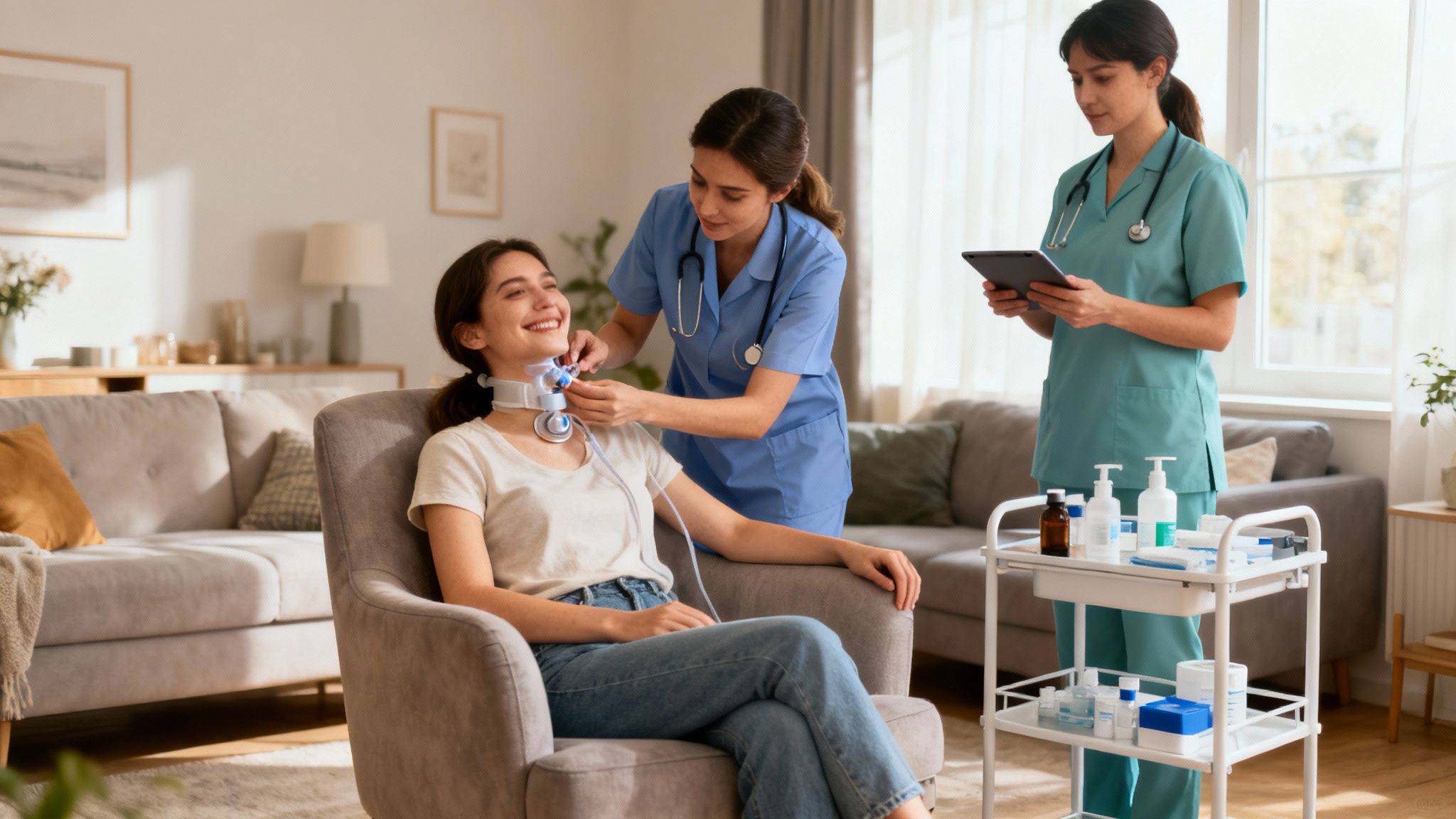
Why Clinical Care at Home Prevents Hospital Stays
Having a high-quality nurse visit you at home isn't just about comfort and convenience. It’s a proactive way to stay healthy and avoid unnecessary trips to the hospital. When a qualified professional provides consistent, complex care in a familiar environment, it helps stabilise health conditions and flag potential problems before they escalate into emergencies. That continuity is key to living independently for the long haul.
What does this look like in practice? Here are a few examples of these essential nursing services:
- Tracheostomy Management: A registered nurse can handle routine care, suctioning, and site cleaning to keep the airway clear and prevent infections.
- Complex Wound Dressings: After surgery or an injury, a nurse can manage wounds that need specialised dressings and careful monitoring, which helps you heal faster at home.
- Enteral (PEG) Feeding: Nurses can oversee feeding schedules, flush tubes to avoid blockages, and check the site for any signs of trouble.
This kind of professional oversight provides immense peace of mind. It turns your home into a safe and effective setting for ongoing medical treatment. If you're looking into your options, getting a full picture of the support available for chronic condition management can really help clarify how these services fit into your NDIS plan.
Here's a closer look at how these specialised services meet specific needs.
Essential In-Home Support Services
See how specialised in-home nursing and personal care services address common support needs to enable independent living.
| Common Support Need | In-Home Clinical Solution | Impact on Independence |
|---|---|---|
| Medication Management | Nurse administers injections, manages complex medication schedules, and monitors for side effects. | Ensures health stability, preventing hospitalisations and enabling a consistent daily routine. |
| Post-Surgical Recovery | Nurse provides complex wound care, pain management, and monitors vital signs at home. | Allows for a comfortable and safe recovery in a familiar environment, avoiding extended hospital stays. |
| Respiratory Support | Nurse manages ventilators, tracheostomy care, and provides oxygen therapy. | Provides life-sustaining support that allows individuals to live safely outside of a clinical facility. |
| Mobility & Hygiene | Personal care worker assists with transfers, showering, dressing, and grooming. | Promotes dignity, personal comfort, and the ability to start and end the day on one's own terms. |
Ultimately, these services work hand-in-hand to build a robust support system that makes independent living not just possible, but sustainable.
True independence is not the absence of support, but the presence of the right support. For those with complex health needs, skilled in-home nursing is the cornerstone that makes a self-directed life possible and safe.
Meet Sarah: A Real-World Example of Coordinated Care
Let's look at Sarah to see how this all comes together. Sarah is a young woman with complex health needs who is determined to go to uni and live in her own apartment nearby. Without the right support structure, she might have been stuck in a specialised facility, miles away from her friends and classes.
That wasn't the future Sarah wanted. Instead, she and her support coordinator designed a team that combines personal and clinical care, all funded through her NDIS plan.
- Her Personal Support Team: Support workers visit in the morning to help her get ready and in the evening to assist with dinner and her bedtime routine. They also give her a lift to and from lectures and social events.
- Her In-Home Nursing Team: A dedicated team of registered nurses comes in daily to manage her ventilator, administer specialised medications, and provide catheter care. They work on a rotating schedule to give her 24/7 clinical oversight.
This coordinated approach is the secret to Sarah's success. Her support workers empower her to chase her educational goals and be part of her community, while her nursing team makes sure her health is managed safely and professionally. It’s a structure that gives her the freedom and control to live life on her own terms, proving that even the most complex health needs don’t have to stand in the way of independence.
Your Practical Roadmap to Independent Living
Making independent living a reality isn't just a dream; it's a project. And like any good project, it needs a clear, practical plan. It’s all about turning your vision into concrete steps, getting ready for any bumps in the road, and making sure you have the right people in your corner.
The journey always starts with a simple question: what does independence actually look like for you? It's a deeply personal thing. Maybe it's moving into your own apartment, learning to cook your favourite meal, or just having full control over your day-to-day schedule. Once that picture is clear, you can work with your Support Coordinator to shape these dreams into solid, measurable NDIS goals.
Reframing Risk as Safety Planning
One of the biggest things that can hold people back is the "what if?" What if something goes wrong? Instead of getting stuck on "risk management," which sounds a bit scary and restrictive, let's flip the script and call it proactive safety planning. This simple change in mindset shifts the focus to creating reliable backup systems that give you the confidence to handle the unexpected.
It helps to think through a few scenarios and map out your response.
- Technology Failure: What's the plan if your smart home tech suddenly goes offline? It could be as simple as having a manual backup and making sure a support worker or neighbour knows how to use it. For example, having a physical key hidden in a lockbox in case a smart lock fails.
- Support Worker Absence: If your regular support worker can't make it, who do you call first? Your plan might involve having a secondary provider on standby or a family member who can help out in a pinch. A practical step is saving the after-hours contact number for your provider in your phone.
- Medical Issues: For non-emergency health concerns, have a clear protocol for who to contact and what information they'll need right away. An example is having a document on your fridge with your doctor's contact details, a list of current medications, and any allergies.
Exploring Innovative Living Models
For a long time, group homes were one of the main options. But today, newer and more flexible models are giving people far more choice. Individualised Living Arrangements (ILAs) are a fantastic alternative, offering a personalised approach that often works out to be more cost-effective too.
ILAs are really changing how we think about NDIS supports by putting choice and control front and centre. A recent report highlighted something huge: if just 500 more participants a year chose ILAs over traditional group homes, the NDIS could save a massive $260 million over five years. That’s because ILAs are often more affordable than standard Supported Independent Living (SIL) funding, which has seen its costs jump by 28% in the last five years alone.
Choosing the Right Provider
Picking your provider is one of the most critical decisions you'll make. You need to be sure they can genuinely meet your needs, especially if they are complex, and that means asking some direct questions.
A great provider won't just deliver services; they'll act as your partner. They’ll listen to what you want to achieve, respect your decisions, and work alongside you to build a support system that truly champions your independence.
When you’re meeting with potential providers, have these questions ready to go:
- How do you develop a personalised care plan, and how often do you review it with me?
- Can you tell me about your staff's specific experience with my health conditions?
- How do you handle communication between your nurses, my support workers, and my GP?
- If I have feedback or a complaint, what's your process for dealing with it?
By arming yourself with a solid plan, understanding all your options, and not being afraid to ask detailed questions, you’ll be in the driver's seat. For a closer look at the types of support available, you can learn more about our disability home care services. And don't forget, an independent life is also a connected one—planning accessible group excursions is a brilliant way to get out and about in the community.
Got Questions About Independent Living? We’ve Got Answers
Stepping into independent living is a big move, and it’s completely normal to have questions swirling around. Let's break down some of the most common ones we hear, giving you the clear, practical answers you need to move forward with confidence.
How Do I Know If I'm Eligible for NDIS Independent Living Supports?
Eligibility for the NDIS hinges on a few key things: your age, your residency status, and whether you have a disability that's considered permanent and significant. But to get specific funding for housing supports like SIL or SDA, you need to show that independent living is one of your core goals in your NDIS plan.
This is where evidence comes in. You'll need reports from allied health professionals, especially an Occupational Therapist, along with your doctor. These documents need to paint a clear picture of why you need a higher level of support to live on your own terms. For example, an OT report might specify that you require a home with no stairs and wide doorways due to your mobility needs, directly linking your disability to the need for specific housing supports. A great Support Coordinator is worth their weight in gold here—they know exactly how to gather the right evidence to make a solid case to the NDIA.
What's the Difference Between a Support Worker and an In-Home Nurse?
While both are crucial for independent living for disabled people, they play very different roles. Think of a support worker as your partner in daily life. They're there to help with personal care, get meals sorted, and support you to get out and about in the community. Their focus is all about helping you achieve your personal and lifestyle goals. For example, a support worker might assist you with grocery shopping and then help you prepare meals for the week.
An in-home registered nurse, on the other hand, provides clinical care—the kind of support that requires medical training.
This could be anything from complex wound care and administering specific medications or injections to managing a tracheostomy or ventilator support. For many people with complex health needs, having both a support worker and a nurse working in sync is the key to living safely and well at home.
How Can I Find a Good In-Home Nursing Provider in Sydney?
The official NDIS Provider Finder tool is an excellent place to start. You can filter your search for registered nursing services right in your own postcode. It's really important to choose a provider that is registered with the NDIS Quality and Safeguards Commission, which means they've met strict national standards for safety and quality.
Once you have a shortlist, don't be shy. Call them up and ask direct questions about their experience with your specific health needs. Find out what training their nursing staff have. A top-notch provider will be open, happy to collaborate, and eager to work with you and your medical team to create a care plan that’s built around you. For example, you could ask, "Have your nurses worked with people who use a PEG feeding tube before, and what specific training do they receive?"
At Core Nursing Solutions Pty Ltd, our passion is providing person-centred, high-quality in-home nursing and support that helps you reach your independent living goals. Learn more about how our skilled team can support you.