

Navigating your NDIS plan can feel a bit overwhelming at times. But Assistance with Daily Life is one of the most important support categories, designed to help you manage everyday personal tasks. It’s a flexible part of your Core Supports budget, there to give you the freedom to live more independently at home and in the community.
What NDIS Assistance with Daily Life Really Means

It helps to think of your NDIS Core Supports budget as a toolkit. Within that kit, ‘Assistance with Daily Life’ is the set of essential, hands-on tools you might need every single day. This funding isn’t about learning new skills—that’s covered elsewhere. It’s about getting practical help with ongoing personal activities that are difficult because of your disability.
This support is designed to be practical and responsive to what you actually need. It recognises that independence looks different for everyone and provides the help necessary to live safely and with dignity. For instance, for one person, it might be help with grocery shopping once a week. For another, it might be 24/7 in-home nursing for complex health needs.
The Goal: Fostering Independence at Home
The main aim of Assistance with Daily Life is to support your wellbeing so you can engage more with your community. It covers a huge range of activities, from simple household chores to highly specialised clinical care delivered by trained professionals.
For example, this support could mean:
- A support worker visiting in the morning to help with showering, dressing, and making breakfast, so you can start your day on your own terms. For example, if joint stiffness makes it difficult to button a shirt, a support worker can provide that hands-on help.
- A registered nurse managing complex medication routines, like injections for diabetes, to make sure your health is properly looked after at home.
- Help with meal preparation to ensure you’re eating nutritious meals, especially if you have a condition like dysphagia that makes swallowing difficult. A practical example is a support worker pureeing food to the correct texture to prevent choking.
What This Guide Will Cover
Throughout this guide, we’ll break down exactly what ‘Assistance with Daily Life’ includes. We will explore everything from basic personal care support to high-intensity clinical services like tracheostomy and ventilation care. This will help you make informed decisions about the support that’s right for you.
The real power of this funding is its flexibility. It can be tailored for a few hours of help a week with grocery shopping or scaled up to 24/7 in-home nursing for complex health needs—all from the same Core Supports category.
We’ll also walk you through the NDIS process and look at how funding is decided. Followed by the steps to get these vital supports into your plan. For those living in the Sydney to Wollondilly region, we’ll provide guidance on finding and working with the right providers. By the end, you’ll have a clear roadmap to confidently access the daily assistance you need to achieve your goals.
What Kinds of Assistance with Daily Life Can I Get?

Getting your head around what assistance with daily life NDIS funding actually covers is the first step to making it work for you. This isn’t just one type of service. Instead, think of it as support that can range from help with everyday personal tasks to highly complex clinical care.
This spectrum is generally broken down into two main areas: general personal care and high-intensity clinical care. The great thing is that both are funded from your Core Supports budget. This shows just how flexible your NDIS plan can be.
Everyday Personal Care and Household Help
This is the foundation of daily support. It involves a support worker giving you hands-on help with tasks that have become difficult because of your disability. The whole point is to help you manage your daily routine with dignity and consistency.
It’s really about having a reliable helping hand for the essential parts of your day. These supports are practical and focused on making your life at home more manageable.
For example, this might look like:
- Getting Your Day Started and Finished: A support worker can help with showering, getting dressed, grooming, and toileting. This makes mornings smoother and evenings more comfortable. For instance, they could help you use a shower chair safely or assist with shaving.
- Help at Mealtimes: Assistance with preparing meals, cooking, or even help with eating if you need it. This ensures you’re getting regular, nutritious food. A practical example is someone who needs their food cut into bite-sized pieces due to vision impairment or dexterity challenges.
- Keeping Your Home in Order: Support with essential cleaning, laundry, and general tidying to keep your living space safe and healthy. This could involve vacuuming floors to reduce trip hazards or changing bed linens.
- Moving Around at Home: Help with getting around your house, getting in and out of bed, or using mobility aids safely. A support worker could provide a steady arm to help you transfer from your wheelchair to a sofa.
These services are the bedrock of in-home support, making a huge difference to your personal health and wellbeing.
High-Intensity and Complex Clinical Care
For participants with more involved health needs, assistance with daily life steps up a notch into the clinical space. These are supports that need a qualified professional, like a Registered Nurse, because they require specialised skills.
This is where the support feels more medical, but it’s all delivered in the comfort and familiarity of your own home. It’s like bringing hospital-level care to you, allowing you to manage complex conditions without having to stay in a clinical facility.
This level of care is so important for participants who need ongoing medical attention. It ensures complex health needs are managed safely at home. This helps prevent complications and leads to better health in the long run.
The demand for these specialised in-home services has really taken off. In fact, the assistance with daily life NDIS sector is a booming industry, with revenue expected to hit $45.0 billion in 2025. This growth shows how providers offering specialised services like complex bowel management, catheter care, and dysphagia support fit right into an NDIS plan.
To give you a clearer idea, here are some practical examples of the high-intensity supports we can fund:
- Ventilation Support: A trained nurse managing equipment like non-invasive ventilation (NIV) or Bi-level Positive Airway Pressure (BiPAP) machines for respiratory conditions, ensuring settings are correct and the mask fits properly overnight.
- Tracheostomy Management: A nurse performing daily care, cleaning, and suctioning of a tracheostomy tube to keep airways clear and prevent infections.
- Complex Wound Care: A qualified professional assessing and dressing a complex or chronic wound, such as a pressure sore, to promote healing and prevent infection.
- Enteral Feeding: A clinician managing nasogastric or PEG feeding tubes, including administering nutrition and medication through them at scheduled times.
- Catheter and Bowel Care: A nurse providing specialised help with urinary catheters or implementing a complex bowel management routine to maintain hygiene and prevent complications.
Providers with multidisciplinary teams are set up to handle this full range of needs. You can learn more about how a provider organises these diverse disability home care services into a seamless plan. This means you have access to a reliable team when you need a hand with breakfast or ventilation support.
How NDIS Decides Funding for Assistance with Daily Life
When it comes to getting funding for assistance with daily life NDIS supports, you’ll hear one phrase over and over: reasonable and necessary. This isn’t just NDIS jargon; it’s the lens through which they view every request.
Think of it as telling a story. You need to show how a specific support is the bridge that connects you from where you are now to where you want to be. It’s all about demonstrating how that help is an essential part of your journey towards living a more independent life.
The Reasonable and Necessary Test
For any support to be funded, it has to pass the NDIS’s reasonable and necessary test. This means the support must clearly relate to your disability, help you reach your goals, and be considered value for money.
It’s not enough to say, “I need a cleaner.” Instead, you paint the full picture: “My disability causes severe fatigue and mobility issues, making it unsafe for me to clean my floors. This creates a serious fall risk. With a support worker for two hours a week to vacuum and mop, my home will be safe, and I can use my limited energy for my weekly hydrotherapy sessions which improve my mobility.”
The key is to shift the conversation from what you can’t do to what you could do with the right support. It’s about focusing on how assistance with daily life NDIS funding is an investment in your independence, safety, and community participation.
Gathering the Right Evidence
To make your case effectively, you need solid evidence that outlines your functional capacity—what you can and can’t do day-to-day. This is what helps your NDIS planner truly understand your situation and approve the right funding.
The best evidence comes from qualified professionals who know you and your disability well. It’s not just about a diagnosis; it’s about the real, practical impact on your daily life.
Effective evidence includes:
- Occupational Therapist (OT) Reports: These are gold. An OT can assess you in your home and provide a practical report stating, for example, “John requires 1 hour of assistance each morning for showering and dressing due to limited shoulder mobility.”
- GP or Specialist Letters: A letter from your doctor can connect your medical condition directly to your daily living needs. For instance, a neurologist might write, “Due to the progression of Multiple Sclerosis, Jane now requires assistance with meal preparation to manage fatigue and tremors.”
- Personal Statements: Never underestimate your own voice. A statement from you or a carer can powerfully describe your daily challenges and goals. You could write, “I often skip meals because I don’t have the energy to cook. Having a support worker to help prepare meals would mean I eat regularly and maintain my health.”
This paperwork paints a clear and undeniable picture for the NDIS, making it much easier to justify the funding you need in your Core Supports budget.
Adapting Support as Your Needs Evolve
One of the best things about the NDIS is that your plan isn’t set in stone. It’s designed to grow and change right alongside you.
Imagine someone with a progressive condition. At first, their plan might cover a few hours of personal care each week for things like showering and help with meals. But as their condition changes over the years, their needs will naturally become more complex.
The NDIS is built for this. A plan review, backed by new reports from their OT and neurologist, could lead to increased funding. This might cover:
- Help with moving around the home safely using a hoist.
- Overnight support to ensure they are repositioned regularly to prevent pressure sores.
- Eventually, high-intensity nursing care for complex needs like medication management via a PEG tube or respiratory support.
This shows how assistance with daily life NDIS funding is a responsive, long-term system. When you bring on new providers to meet these changing needs, it’s best to get a transparent service agreement. You can learn more about what to include by looking at an NDIS service agreement template. This makes sure everyone is on the same page as your support grows.
A Step-By-Step Guide to Getting Assistance with Daily Life
Navigating the NDIS to get the right support can feel overwhelming, but when you break it down into clear steps, it becomes much more manageable. Think of it less like a single, high-stakes event and more like a series of conversations where you explain your needs and what you want to achieve.
With the right preparation, you can confidently steer your NDIS plan towards the outcomes you want. This guide will walk you through the key stages, from gathering your evidence to explaining your needs in the planning meeting. We’ll show you how to connect your daily challenges to specific support requests, turning broad goals into practical, funded assistance.
Step 1: Prepare Your Evidence
Before you even think about your planning meeting, your main job is to gather solid evidence. This isn’t just about proving you have a diagnosis; it’s about painting a clear picture of how your disability impacts your everyday life. The NDIS planner needs to understand why you need funding for assistance with daily life.
Think of yourself as building a case. Every report and assessment is a building block that strengthens your request for funding. The clearer the picture you create, the easier it is for the NDIS to approve the supports that will actually make a difference.
The most powerful evidence usually comes from allied health professionals who can assess your functional capacity. This includes:
- Occupational Therapy (OT) Assessments: These are often the gold standard. A practical example is an OT report that details how long it takes you to shower and dress independently versus with support, quantifying the need for assistance.
- Reports from Specialists: A letter from your neurologist, respiratory physician, or GP can draw a direct line between specific medical needs and the requirement for in-home clinical care. For instance, a report might state, “This patient requires daily wound care from a registered nurse for a non-healing leg ulcer.”
- A Personal Impact Statement: Don’t underestimate this! Writing down your daily routine, noting the challenges you face and what you hope to achieve with support, can be incredibly persuasive. For example: “On Monday, I was too fatigued to cook and had toast for dinner. With support, I could have a nutritious meal.”
Step 2: Define Your Goals Clearly
The NDIS is all about goals, so linking your support needs to your personal goals is absolutely critical. Vague goals like, “I want to be more independent,” are really hard for a planner to fund. Instead, you need to focus on specific, measurable, and practical outcomes.
This is your chance to be direct about what a good day looks like for you. When you break a big goal down into smaller, tangible steps, it becomes much easier for a planner to see exactly what support is needed to get you there.
For instance, instead of a general goal, try one of these:
- “I want to prepare my own breakfast safely every morning.” This goal immediately points to a need for a support worker to help with meal prep or provide supervision in the kitchen.
- “My goal is to manage my complex medication schedule without errors to stay healthy at home.” This is a perfect justification for funding a registered nurse to give injections or manage a medication pump.
- “I want to continue living in my own home, which requires support with showering and dressing each day.” This directly connects personal care to the huge goal of maintaining your living situation.
The infographic below shows how this simple process works—turning your evidence and goals into funded support.
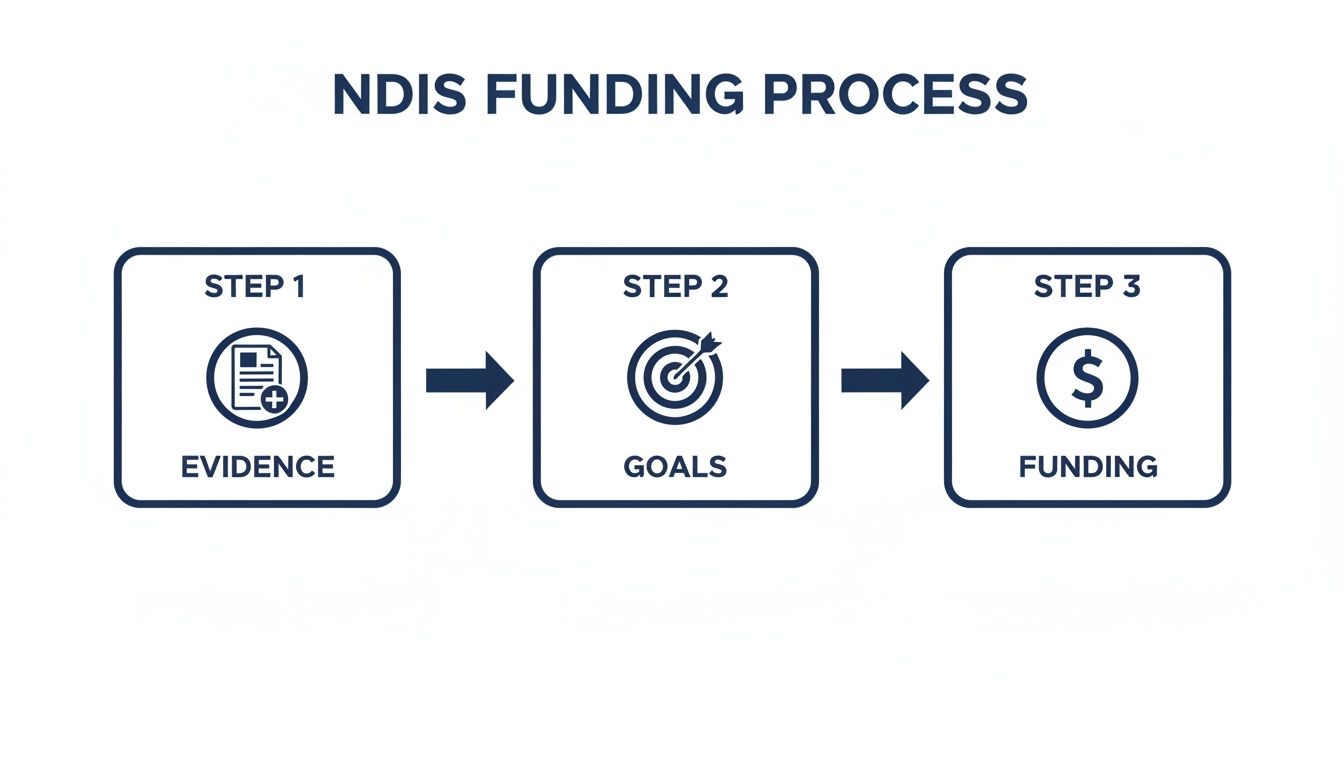
This visual makes it clear: solid evidence plus well-defined goals lead directly to the funding you need in your plan.
Step 3: Articulate Your Needs in the Planning Meeting
Your planning meeting is where all your preparation pays off. Use your evidence and goals to guide the conversation. Be ready to explain how each requested support is “reasonable and necessary” for you to live an ordinary life.
Let’s think about Sarah from Wollondilly, who has a progressive neurological condition. She was very clear in her meeting: “To manage my dysphagia, I need a support worker trained in mealtime assistance for two hours each day. My speech pathologist’s report confirms this. This will prevent choking and ensure I get enough nutrition, which is my main health goal.”
By being so specific, Sarah connected her condition (dysphagia) to a risk (choking) and a goal (nutrition). This made it simple for the planner to approve the necessary support. Taking this practical approach is the key to getting the assistance with daily life funding you need included in your plan.
Finding the Right Provider for Assistance with Daily Life

Choosing a provider for your assistance with daily life NDIS funding is a huge decision. This isn’t just about hiring a service; it’s about building a relationship based on trust, respect, and clear communication.
The right provider becomes a key part of your day-to-day life, and that’s especially true when you’re managing complex health needs. It’s about finding a team that truly gets your situation, has the right qualifications, and listens in a way that makes you feel heard.
Key Questions to Ask Potential Providers
Before you sign on with anyone, it’s so important to ask the right questions. Think of it like an interview where you’re the one in charge of hiring. This helps make sure their skills and approach are the right fit for you.
Here’s a simple checklist to help guide those chats:
- Are you a registered NDIS provider? This is non-negotiable. It confirms they meet the standards set by the NDIS Quality and Safeguards Commission.
- What are your staff’s qualifications? Be specific. Personal care: are they certified support workers? Clinical tasks: are they Enrolled or Registered Nurses? For example, “Are your nurses trained in managing ventilator alarms?”
- What’s your team’s experience with my specific condition? For example, you could ask, “Can you tell me about your experience managing at-home tracheostomy care for other clients?”
- How do you handle communication? You’ll want to know if you’ll have one main contact person and how they plan to coordinate with your GP or other health professionals. A practical question is, “If I have a concern at 8 pm, who do I call?”
- What’s your process for creating a care plan? A good provider will involve you and your family at every stage to ensure the plan reflects your personal goals. Ask them, “Can you walk me through how you would develop my initial care plan with me?”
The quality of your support really comes down to the quality of your relationship with the provider. The best partnerships are built on feeling comfortable enough to voice concerns, celebrate wins, and adjust your support plan together as things change.
The Advantage of a Coordinated Care Team
For anyone with high-intensity needs, finding a provider who offers a coordinated, big-picture approach is a game-changer. This means they don’t just show up to do one task in isolation.
Instead, they act as a central hub, talking with your whole care team—your GP, specialists, and allied health professionals—to keep everyone on the same page. This is vital when you’re managing complex supports at home. For example, your in-home nurse might notice a change in your wound and can immediately contact your GP for a medication review. By the way, if you’re looking for more information on local support, you might find our guide on finding an NDIS provider in Sydney helpful.
This kind of proactive coordination can prevent complications, ensure your care plan is always up to date, and save you from the stress of having to repeat the same information over and over to different people.
As of 2025, the NDIS is supporting over 460,000 participants. Those over 65 are receiving the highest average payments of $90,500 per year. This funding often goes towards essential daily supports like tracheostomy care and complex wound management—services that registered providers like Core Nursing Solutions deliver. To learn more about what’s ahead, you can read about the future of NDIS changes and developments from this research.
Managing Your NDIS Budget for Assistance with Daily Life
Once you have funding for assistance with daily life NDIS supports in your plan, the next step is figuring out how to manage it. How you handle your funds really shapes the amount of choice and control you have over your providers and how much admin work lands on your plate.
You have three main options for managing your NDIS plan. The right one is all about your personal preference and how hands-on you want to be. There’s no single “best” way; it’s about what works for you.
Understanding Your Plan Management Options
Each management style offers a different balance of flexibility and support. Getting your head around the pros and cons is the key to making a confident decision.
- NDIA-Managed (Agency-Managed): With this option, the National Disability Insurance Agency (NDIA) pays your providers directly from your plan. It’s the most hands-off approach, but it comes with a catch: you can only use NDIS-registered providers.
- Plan-Managed: Here, you bring in a plan manager who acts as your financial go-between (at no extra cost to you). They pay your invoices, keep track of your spending, and handle all the paperwork. This gives you the freedom to use both registered and non-registered providers.
- Self-Managed: You’re in the driver’s seat. The NDIA pays the funds directly to you, and you pay your providers yourself. This offers maximum flexibility, letting you negotiate rates and choose anyone you want, but it also means you’re responsible for all the financial admin.
For many people, a plan manager hits that perfect sweet spot. It takes the stress of invoices and budgets off your shoulders while still giving you plenty of choice. For instance, if you’re coordinating multiple supports, like a support worker, a nurse, and a cleaner, a good plan manager can lift a huge weight by dealing with all the different bills.
Choosing your plan management style is really about deciding how you want to spend your time and energy. Do you want to focus on finding the right supports and let someone else handle the bills, or do you prefer to have direct control over every dollar?
Tips for Staying on Top of Your Budget
No matter how your plan is managed, keeping an eye on your spending is crucial. Running out of funds unexpectedly can throw your essential daily supports into chaos.
A great place to start is with a clear service agreement for each provider. This document lays out the agreed-upon rates, travel costs, and cancellation policies so there are no nasty surprises on your invoices. To get a better feel for this, you can look at a service agreement template for NDIS to see what should be included.
If you notice your funds are getting low, don’t panic. The first step is to get in touch with your Support Coordinator or Local Area Coordinator (LAC). They can help you go over your spending and, if your needs have changed, guide you through requesting a plan review to seek more funding. For a practical example, if you’ve had a recent hospitalisation and now need more support at home, that’s a perfect reason to request a review.
Frequently Asked Questions
When you’re trying to understand NDIS funding, a lot of practical questions can pop up. We hear them all the time. Here are some straightforward answers to the most common queries about Assistance with Daily Life.
Can a Family Member Be Paid for Assistance with Daily Life Care?
Generally, the NDIS doesn’t fund family members to provide paid support. The whole idea behind the scheme is to connect you with professional support workers, which helps keep personal relationships from getting strained.
There are, however, very rare exceptions. For instance, if you live in a remote area hours away from the nearest registered provider, or for specific cultural reasons, the NDIA might consider it. This is always looked at on a case-by-case basis and needs solid evidence to prove it’s the only workable solution.
How Is Assistance with Daily Life Different from Supported Independent Living?
It’s a great question, as both supports help with daily tasks but on a very different scale. Think of Assistance with Daily Life as funding for specific, scheduled help. For example, a support worker might come for two hours in the morning to help with showering and breakfast, and another hour in the evening to help with dinner. You can use this funding flexibly when you need it.
On the other hand, Supported Independent Living (SIL) is a much bigger, all-in-one support package. It’s designed for people with higher support needs who require assistance around the clock, including overnight. SIL is a bundled payment that covers all the person-to-person support, usually in a shared living home where staff are on-site 24/7.
My Needs Have Changed. How Do I Request More Funding?
Life changes, and the NDIS is built to change with you. If your circumstances have shifted and you need more support, you can ask for a plan review or what’s called a ‘change of circumstances’ review.
To get the ball rolling, you’ll need to gather fresh evidence that clearly explains why you need the extra help. This could include things like:
- An updated functional assessment from an Occupational Therapist (OT) showing, for example, that you can no longer transfer from your bed to a chair without a hoist and two support workers.
- A letter from your doctor or specialist that details the changes in your condition, such as a decline in mobility after surgery.
- A report from your current provider explaining why they’ve seen an increased need for support. For instance, they might note that meal preparation now takes twice as long due to increased fatigue.
Giving this new evidence to the NDIA is the key to adjusting your assistance with daily life NDIS funding so it properly matches what you need today.
Can I Use Assistance for Daily Life for Support During a Holiday in Australia?
Yes, absolutely! Your support needs don’t just stop because you’re on holiday. You can definitely use your funding to pay for a support worker to help with personal care, meals, or getting out and about while you’re travelling anywhere in Australia.
Just keep in mind that the NDIS only covers the cost of the support worker’s time. It won’t pay for their personal travel, accommodation, or food costs. You’ll need to chat with your provider about these extra expenses beforehand and agree on how they’ll be paid for separately. For example, if you go to the Gold Coast for a week, you’d use your NDIS funds to pay for the support worker’s hourly rate, but you would pay for their flight and hotel room out of your own pocket.
Managing complex health needs at home is much easier with a skilled and compassionate team you can trust. Core Nursing Solutions Pty Ltd delivers expert in-home nursing and support from Sydney to Wollondilly, making sure your care is safe, reliable, and all about you. Find out more about how we can support your independence at https://corenurses.com.au.
Pingback: The Guide You Need to Empower Your Home Care Journey - Core Nursing Solutions
Pingback: Your Ultimate Guide to NDIS In Home Care - Core Nursing Solutions