
Home care services in Sydney mean you get professional support, from personal assistance to complex medical care, right in your own home. It’s a way for people to keep their independence and dignity while receiving the expert care they need. Think of it as a flexible alternative to residential care, focused on the comfort of familiar surroundings. For example, instead of a senior moving into an aged care facility, a registered nurse can visit their Penrith home daily to manage their diabetes and help with mobility, allowing them to stay in the house they’ve lived in for 40 years.
What Home Care in Sydney Actually Looks Like
Forget the idea of a sterile, clinical environment. Real home care is about weaving professional support into the fabric of your daily life. It’s a partnership designed to empower you or your loved one to live safely and comfortably in the place that means the most—home.
For example, imagine a registered nurse visiting your family member in their Wollondilly home to manage complex wound care after a hospital stay. That same nurse can also coordinate with their GP and physio, making sure everyone is on the same page with the recovery plan. This kind of seamless support often prevents re-hospitalisation and gives families incredible peace of mind.
Beyond Basic Assistance
While help with daily routines like meal prep and personal hygiene is a huge part of what we do, modern home care goes much further. It now includes a wide range of clinical services that, in the past, you could only get in a hospital.
For many families in Sydney, this means having access to highly skilled professionals who can manage complex needs such as:
- Medication Management: A practical example would be a nurse setting up a weekly medication dispenser for an elderly client with memory issues and visiting to administer a monthly vitamin B12 injection, ensuring no doses are missed.
- Specialised Clinical Tasks: This could involve a trained nurse visiting a client's home in Campbelltown to manage their ventilator overnight, allowing the family to get a full night's sleep knowing their loved one is safe.
- Chronic Disease Support: A nurse might help a client with Chronic Obstructive Pulmonary Disease (COPD) monitor their oxygen levels, use their nebuliser correctly, and recognise early signs of an infection, helping to avoid emergency hospital visits.
This whole approach is about person‑centred care. The focus shifts from just treating a condition to supporting the individual's overall wellbeing, their personal goals, and their lifestyle choices, all within their own community.
A Team Dedicated to You
When you choose home care services in Sydney, you’re not just hiring one person; you’re bringing on a dedicated team. This team works together to build a complete support structure around you. For instance, a support worker might help with morning routines, while a registered nurse visits later to change a catheter or manage a tracheostomy.
This coordinated model ensures every aspect of a person’s health is looked after. To see how these different roles and supports fit together, you can explore a full list of our home nursing and disability services to understand the breadth of care we can provide at home. It’s this integrated approach that allows people with even the most complex health needs to thrive in a familiar, comforting environment.
Exploring the Full Spectrum of In-Home Care Services
When you start looking into home care services in Sydney, it's best to think of the support available on a spectrum. On one end, you have personal care that helps with daily living. On the other, you have highly specialised clinical care for complex medical conditions. Understanding this full range helps you feel confident that almost any health need can be met safely and professionally at home.
The journey often starts with personal care and daily living support. This is about much more than just basic tasks; it's about upholding dignity, maintaining routine, and preserving a sense of self.
This foundational support is what allows people to stay connected to their lives and communities. It’s what makes a house continue to feel like a home.
Personal Care and Daily Living
This type of support focuses on the everyday activities that may have become a challenge. Think of it as having a trusted helper who makes it possible to maintain independence and stick to personal routines.
A few practical examples include:
- Morning and Evening Routines: A carer might arrive at 7:30 AM to help an elderly gentleman with Parkinson's to safely shower, shave, and get dressed, so he's ready for his family to visit.
- Mealtime Support: A support worker could assist a client who has difficulty swallowing (dysphagia) by preparing texture-modified meals and providing gentle encouragement during mealtimes to ensure they receive proper nutrition.
- Mobility Assistance: For someone recovering from a hip replacement, a carer could provide steady support during their prescribed daily walks around the garden, helping them regain strength and confidence safely.
These services are the bedrock of quality in-home care, creating a safe and comfortable environment in familiar surroundings. From here, more specialised support can be layered on as needed, creating a care plan that is truly built around the individual. The diagram below shows how this structure works, with tailored care built on a strong support system to maintain independence.
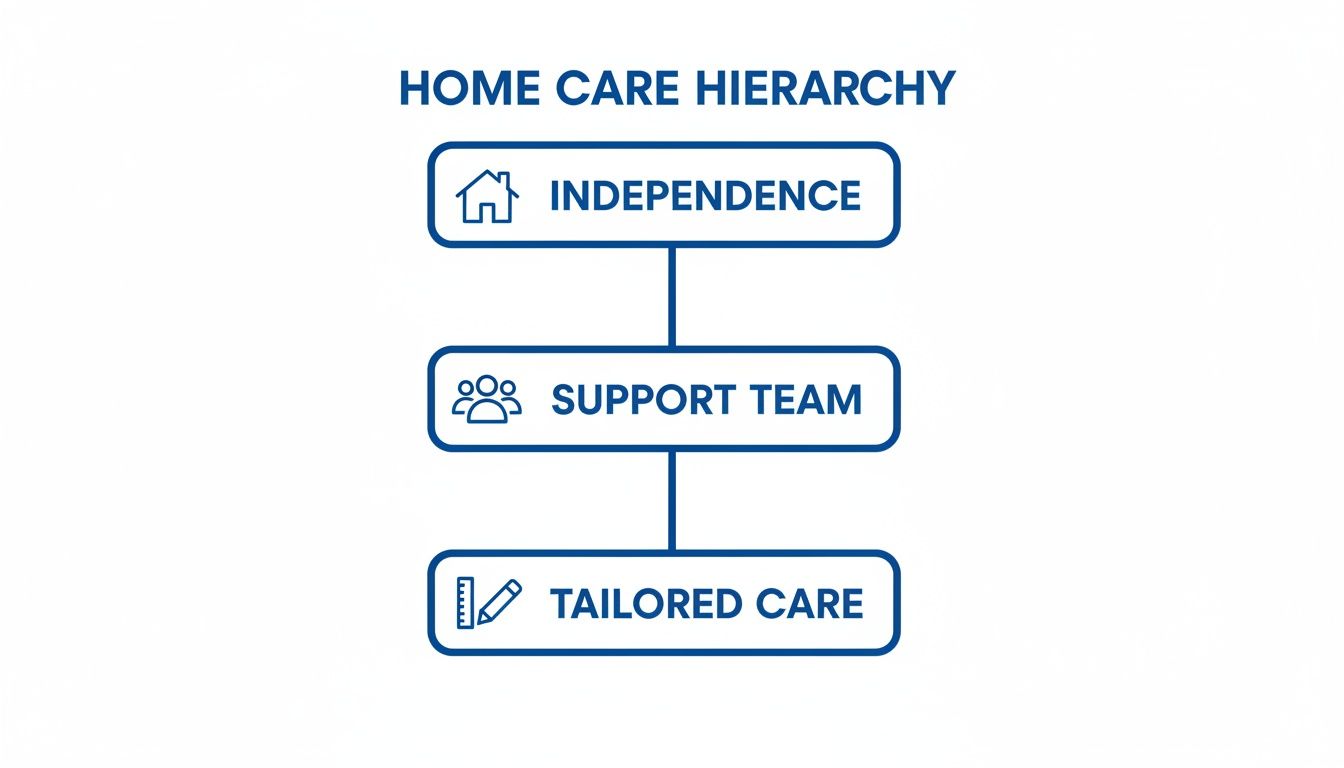
This visual makes it clear: the ultimate goal of independence is reached through a coordinated support team delivering care designed for specific, individual needs.
Advanced Clinical Care at Home
As we move further along the spectrum, we get into clinical and high-intensity nursing care. This is where the skills of a Registered Nurse are absolutely essential. These are services that once meant a hospital stay but can now be delivered with precision and safety right in your own living room.
Picture a Registered Nurse visiting a home in the Wollondilly region to manage a client's ventilator. They don't just check the machine; they conduct a full respiratory assessment, speak directly with the client's GP and respiratory specialist, and teach the family what signs to watch for. That’s proactive, coordinated clinical care in action.
High-intensity support isn't just about performing a task. It's about bringing a hospital-level standard of clinical governance, risk assessment, and skilled intervention into the home.
Having access to this level of care is a complete game-changer for families. It provides a real alternative to long-term hospital stays or residential facilities. Most importantly, it means people can manage serious health conditions while surrounded by the comfort of home and family. Our guide on disability home care services explains more about how these supports fit into a holistic plan.
A Multidisciplinary Team Approach
No single person can do it all. The best results always come from a multidisciplinary team, where Registered Nurses and trained support workers collaborate. The nurse might handle the complex clinical tasks, while the support worker helps with daily routines, creating a complete circle of care.
For example, consider someone who needs enteral feeding through a tube. The Registered Nurse is responsible for managing the tube site, administering the feeds, and troubleshooting any problems. At the same time, a support worker can help with personal care, preparing meals for other family members, and providing valuable companionship.
This collaborative model ensures every need is met.
At-a-Glance Guide to Home Care Services
This table categorises the services we provide, helping you quickly identify the support relevant to your needs and see practical examples of how our care is delivered.
| Service Category | Specific Services Offered | How It Helps in Practice |
|---|---|---|
| Complex Nursing | Tracheostomy care, ventilation support (CPAP/BiPAP), complex wound management. | A Registered Nurse manages airway safety for a client with a tracheostomy, preventing infections and ensuring the equipment functions correctly. |
| Continence Care | Catheter changes (indwelling, suprapubic), complex bowel care regimens. | A nurse provides regular catheter care at home, reducing the risk of urinary tract infections and avoiding frequent, stressful trips to a clinic. |
| Medication Management | Administering scheduled drugs, including injections and subcutaneous infusions. | A support worker ensures oral medications are taken on time, while a nurse visits to administer insulin injections, providing complete medication safety. |
This team-based approach is essential for delivering comprehensive care that addresses the whole person, not just a single medical issue.
The demand for these skilled services has grown massively. The Australian home care workforce more than doubled between 2020 and 2023, growing from 80,340 to 170,000 staff. But this rapid expansion hides a critical problem: the number of Registered Nurses in aged care actually declined during that time. This has created a gap between the need for expert clinical skills and the number of nurses available to provide them. This makes choosing a provider with a strong, credentialed nursing team more important than ever.
Using Your NDIS Plan for In Home Care
Navigating the National Disability Insurance Scheme (NDIS) can feel like learning a whole new language. But it's absolutely the key to funding the essential home care services in Sydney that you or your loved one needs. Your NDIS plan is your personal roadmap, and it outlines all the supports you can access to live more independently.
Think of your plan as a budget, specifically set aside to help you manage your disability. This funding isn't just for one or two things; it can cover a huge range of supports. This could be personal care to help you get ready for the day, or even high-intensity nursing for more complex medical needs. The whole point is to give you choice and control over how, when, and who provides your support.
Understanding "Reasonable and Necessary" Supports
If there’s one phrase you need to get familiar with, it’s “reasonable and necessary.” For the NDIS to cover a support, it has to meet this specific criteria. This isn’t just bureaucratic jargon; it’s the standard that every single request is measured against.
So, what does it actually mean? A support is considered reasonable and necessary if it:
- Is directly related to your disability.
- Helps you work towards your goals and aspirations.
- Assists with your social and economic life.
- Represents good value for money.
For example, getting funding for a registered nurse to manage ventilation at home is a classic case of ‘reasonable and necessary’. It’s directly linked to a medical need, it helps you stay safely at home (which is a huge goal for many), and it’s often more cost-effective than a long-term hospital stay. It’s all about making a logical, evidence-based case for the support you need.
The Power of Clear Goals and Medical Evidence
Securing NDIS funding, especially for complex care, really comes down to two things: having very clear goals and strong medical evidence to back them up. Your NDIS plan isn’t just a shopping list of services; it's built around your personal hopes and ambitions.
Your goals are what drive the funding. A goal like, "I want to live safely in my own home and avoid hospital admissions," gives a powerful reason for funding in-home clinical nursing.
This is where letters and reports from your GP, specialists, and allied health team become so important. A letter from a respiratory specialist that clearly explains why at-home ventilation is clinically required gives the NDIS the proof it needs to approve the funding. Vague requests often get stuck, but a well-supported case is hard to argue with. For instance, a report from an occupational therapist detailing how specific in-home modifications and personal care support will enable a participant to live independently is a powerful piece of evidence.
Your Support Team: Allies in the Process
The good news is, you don’t have to do this alone. Two key people can make a massive difference in your NDIS journey: Support Coordinators and Plan Managers.
A Support Coordinator is like your NDIS guide. They help you make sense of your plan, connect you with quality providers like us here at Core Nursing Solutions, and check that your services are working well for you. In practice, this could mean your Support Coordinator researches three different nursing providers in your area, arranges introductory meetings for you, and helps you compare their service agreements.
A Plan Manager, on the other hand, acts as your financial admin. They take care of paying the invoices from your providers and manage the budget in your NDIS plan. This frees you up from the paperwork so you can focus on your health and wellbeing, knowing the money side of things is being handled professionally.
Putting It All Together: A Practical Example
Let’s walk through how this looks for a family in Sydney. Their son, Alex, has a tracheostomy and needs monitoring 24/7.
- Plan Meeting: First, the family works with their Support Coordinator to create a clear goal: "For Alex to live safely at home with his family and be able to attend school."
- Gathering Evidence: Next, they get letters from Alex's paediatrician and respiratory specialist. These documents confirm the clinical need for skilled nursing care to manage his tracheostomy safely.
- Finding a Provider: The Support Coordinator then helps them find registered NDIS providers in Sydney who specialise in this kind of high-intensity support.
- Service Agreement: Once they've chosen a provider, they put together a service agreement. This document clearly lays out the specific supports, costs, and schedules. If you're wondering what goes into one, you can review this helpful NDIS service agreement template to see the key parts.
- Implementation: With the plan and agreement locked in, the provider can start delivering the in-home nursing care. They work closely with the family and Alex's entire medical team to ensure everything runs smoothly.
This process shows how a well-prepared plan, backed by solid evidence and expert guidance, successfully unlocks the NDIS funding needed for even the most complex home care services in Sydney.
Your Checklist for Choosing the Right Home Care Provider
Choosing a provider for home care services in Sydney is a big decision for any family. This choice goes far beyond a glossy brochure or a nice website. You are bringing a partner into your home to support a loved one's health, safety, and independence. This checklist will help you ask the right questions—the ones that truly show what a provider is made of.
This process is even more critical right now. The demand for home care is huge, and while the sector is growing, it's struggling to keep up. As of June 2024, the national waitlist for Home Care Packages hit 68,586 people—a staggering 124.8% jump from the previous year. This pressure means you need to be absolutely sure your chosen provider can deliver consistent, high-quality care without cutting corners. You can read more about these trends in the KPMG aged care market analysis.
Vetting Clinical Expertise and Staff Competency
First things first, you need to be confident in their clinical skills. This is all about making sure their staff have the right qualifications and ongoing training to safely handle complex medical needs. Don't just accept a simple 'yes' when you ask if they offer a particular service. Dig a little deeper.
Here are some specific questions you could ask:
- For high-intensity needs: "Could you explain your training and competency checks for nurses who will be managing my family member's ventilator at home?"
- Regarding staff qualifications: "What is the ratio of Registered Nurses to support workers on your team? How do you make sure everyone knows their specific role?"
- For ongoing training: "How do you keep your nurses and carers up to date on the best practices for complex wound care or catheter management?"
A good provider will not only welcome these questions but will also give you clear, detailed answers about their credentialing, professional development, and supervision.
Evaluating Safety Protocols and Emergency Preparedness
When care happens in the home, solid safety plans are non-negotiable. You need to know exactly what the procedure is if there's a medical emergency or something unexpected comes up. This is where you see how well-prepared a provider really is.
A provider's emergency plan shouldn't just be an idea; it should be a documented, practiced, and clearly communicated process that every single staff member can follow without hesitation.
Ask them to walk you through their procedures:
- Medical Emergencies: "What is your exact protocol if a client has a medical emergency, like a seizure? For example, who calls 000, who stays with the client, and how is the family notified?"
- Incident Reporting: "How do you manage and report clinical incidents or even near misses? Can you give me an example of a positive change you made after reviewing an incident?"
- Staffing Contingency: "What happens if our regular nurse calls in sick for a shift at 7 AM? How quickly can you get a replacement carer here, and how do you ensure they are fully briefed on my loved one’s specific needs before they walk in the door?"
Understanding Person-Centred Planning and Communication
Finally, great care is a team effort. The provider should see you and your family as key partners in planning and delivering support. Their approach needs to be flexible and responsive, always putting the person's own goals and wishes first.
Look for a real commitment to partnership with these questions:
- Care Plan Collaboration: "How will our family be involved in creating the initial care plan and in its regular reviews? For example, will we have a scheduled meeting every three months?"
- Communication Channels: "Who will be our main point of contact? If we have a non-urgent question on a weekend, what is the best way to get in touch and what is your standard response time?"
- Cultural and Personal Preferences: "My mother only feels comfortable with female carers and speaks Italian as her first language. How can you accommodate these specific needs in your staffing?"
Asking these tough questions will help you find a provider that not only has the clinical skills but also shares your family’s values. Understanding the financial side is also key, and you can learn more about how services are priced by reading our guide to the cost of home care services. By being thorough, you can make a choice that gives you real peace of mind.
A Day in the Life of Coordinated Home Care
The term ‘coordinated care’ can feel a bit abstract. So, what does it actually look like for a family managing complex health needs at home? To make it real, let’s walk through a day with Eleanor, one of our clients in the Wollondilly region. You’ll see exactly how professional home care services in Sydney work in real time.

Eleanor has a chronic respiratory condition that needs careful management. Today is a perfect example of how a collaborative team works together to keep her safe and well in her own home.
The Morning Check-In and Proactive Observation
8:00 AM: Sarah, Eleanor’s regular Registered Nurse from Core Nursing Solutions, arrives. Her visit starts not just with clinical tasks, but with a genuine conversation. While helping Eleanor with her morning medications, Sarah notices something subtle—a slight increase in Eleanor’s effort to breathe that wasn’t there yesterday.
Eleanor says she feels fine, but Sarah’s clinical training tells her to look deeper. She completes a full respiratory assessment, checking oxygen saturation, listening to Eleanor’s lungs, and noting a faint wheeze. It’s not an emergency, but it's a clear signal that something has shifted.
This is the first critical touchpoint. It’s not about ticking boxes; it’s about skilled observation and catching a small change before it becomes a big problem.
The Central Hub in Action
9:15 AM: Instead of just writing down the change and waiting, Sarah becomes the central hub of communication. She immediately does two things:
- Calls Eleanor’s GP: She gives a concise, professional handover using the SBAR (Situation, Background, Assessment, Recommendation) format. She clearly reports the change in breathing, her assessment findings, and suggests a potential medication adjustment.
- Emails the Physiotherapist: Sarah then sends a brief, secure email to Eleanor’s physiotherapist, who is due to visit in the afternoon. This lets him know about the change so he can adjust his planned exercises.
The GP agrees with Sarah’s assessment and faxes a script for a short-term medication change to the local pharmacy. It’s delivered within the hour.
This seamless loop of communication is the heart of coordinated care. The in-home nurse isn't working in isolation; she is the eyes and ears for the entire medical team, connecting all the dots to make sure care is responsive and proactive.
Adjusting the Plan for a Better Outcome
2:00 PM: When Mark, the physiotherapist, arrives, he is already fully up to speed. Instead of going ahead with the standard strength exercises, he pivots to gentle breathing techniques and chest physiotherapy to help clear Eleanor’s airways. This perfectly complements the new medication.
4:30 PM: Sarah calls Eleanor’s daughter, Chloe, to give her an update. She explains what she observed, the actions taken, and the new plan. Chloe is relieved. She knows a small issue was spotted and managed quickly, preventing what could have become a stressful trip to the emergency room over the weekend.
By evening, Eleanor is breathing more comfortably. A potential health crisis was avoided, not through a dramatic intervention, but through a series of small, well-coordinated actions. This story shows how expert home care services in Sydney create a true safety net, giving families peace of mind and allowing their loved ones to thrive safely at home.
Answering Your Key Questions About Home Care
Choosing to bring support into your home is a big decision, and it’s natural to have questions. We hear a lot of the same queries from families across Sydney and Wollondilly, so we’ve put together some straight answers to help you feel more confident.
How Quickly Can We Get Started with Home Care?
Often much faster than you might think. Once you get in touch, we can usually arrange a full in-home assessment within a day or two. After that, we create a care plan that’s tailored to you, and services can start within 24-72 hours, depending on what’s needed.
If you’re facing an urgent situation, like an unexpected discharge from the hospital, we can also organise a rapid response. The main thing is to let us know what you need right away so we can ensure a safe and smooth transition back home. For example, we recently helped a family whose father was discharged from hospital on a Friday afternoon needing wound care over the weekend. We had a nurse visit him that same evening to get everything set up.
Are Your Carers Qualified for Complex Medical Needs?
Yes, absolutely. This is one of the most important differences when you choose a professional provider. Our Registered Nurses and support workers have the right qualifications and are regularly assessed on high-intensity skills to make sure they are up to date.
For instance, a nurse managing tracheostomy care has proven, current training for that specific task. You should always ask a potential provider about their staff training and how they verify credentials for your specific needs. It’s the best way to ensure safety and give you complete peace of mind.
What Happens if Our Regular Carer Is Sick or Away?
This is a really important question and highlights the benefit of using a professional agency. If your regular carer is unavailable, we have a whole team of qualified staff ready to step in. A suitable, fully briefed replacement will be there, so you never have to worry about gaps in your support.
Continuity of care is a core promise. Our system is designed to ensure that even when a regular carer is away, the quality and consistency of your support never change.
For instance, if your regular nurse for morning medication calls in sick, our clinical coordinator will immediately access the client's file, identify another nurse on the team with the right skills who is available, and brief them on the client's specific routine and needs before they head to the home.
How Do You Develop the Care Plan with Our Family?
Creating a care plan is always a team effort. We’ll meet with you and your family to understand not just the clinical needs but also your personal goals and what you like. Your input isn’t just welcome—it’s essential for building a plan that really works for you.
This process also includes important safety checks and risk assessments. For example, as a provider, we have a responsibility to identify and manage potential issues, which is covered in the guidelines for handling NDIS reportable incidents. During an initial assessment, we might notice loose rugs that are a trip hazard and work with the family to find a safer solution. Working together on safety planning means everyone understands their role in keeping the home environment secure. This partnership is what makes in-home care a success.
Ready to take the next step? At Core Nursing Solutions Pty Ltd, we provide skilled, compassionate, and reliable in-home care across Sydney and Wollondilly. We are here to answer all your questions and help you build a support plan that gives you confidence and peace of mind.