

A private nurse at home brings expert clinical care and one-on-one support right to your doorstep. They manage the kind of complex medical needs that would typically mean a trip to a hospital or clinic, all from the comfort and familiarity of your own space. For many people, including NDIS participants, this service is an absolute lifeline, making it possible to live safely and with dignity at home.
What a Private Nurse at Home Really Does

When you hear "private nurse," it’s easy to think of someone just checking blood pressure or handing out pills. While those tasks can be part of the picture, the reality is much bigger. A private nurse at home is a dedicated clinical expert, bringing hospital-grade skills and critical thinking into your living room.
Think of them as the healthcare quarterback for your home. They aren't just ticking off a list of tasks; they're orchestrating a complete care strategy. This means talking directly with doctors and specialists, managing complex medication routines, and performing advanced clinical duties that often prevent emergency room visits and hospital readmissions. For example, a nurse might notice a subtle change in a patient's breathing pattern and liaise with their respiratory specialist to adjust their medication, preventing a potential crisis.
For families, this level of professional oversight brings enormous peace of mind. Knowing a qualified expert is managing a loved one’s health allows you to step back from being a carer and return to being a son, daughter, or partner.
A Practical Example of In-Home Nursing
Let's look at a common situation: someone recovering from surgery. They’re sent home with a complex wound that needs daily dressing changes, constant monitoring for infection, and careful management to heal correctly. For a family member, this can be an overwhelming and stressful responsibility.
This is where a private nurse makes all the difference. They step in to:
- Perform sterile dressing changes with proper clinical technique.
- Assess the wound for any signs of infection or other complications.
- Send progress updates directly to the surgeon or GP, including photos if needed.
- Teach the family what to look for—like increased redness or unusual discharge—and how to help between visits.
This not only helps the person recover faster but also dramatically cuts the risk of complications that could land them back in the hospital. It’s a perfect example of how in-home nursing bridges the gap between hospital care and a safe recovery at home.
A private nurse at home transforms your living space into a safe, effective environment for healing and recovery. They manage the clinical complexities so you and your family can focus on what truly matters—wellbeing and quality of life.
The demand for these services across Australia has skyrocketed, partly driven by long waitlists for government-funded support. As of June 2024, a staggering 68,109 people were approved for but still waiting on Home Care Packages—that's a 138% increase from the previous year. This shortfall makes private nursing a vital lifeline for countless families and NDIS participants. You can read the full analysis of home care demand to see just how significant the need has become.
The Spectrum of In-Home Nursing Services
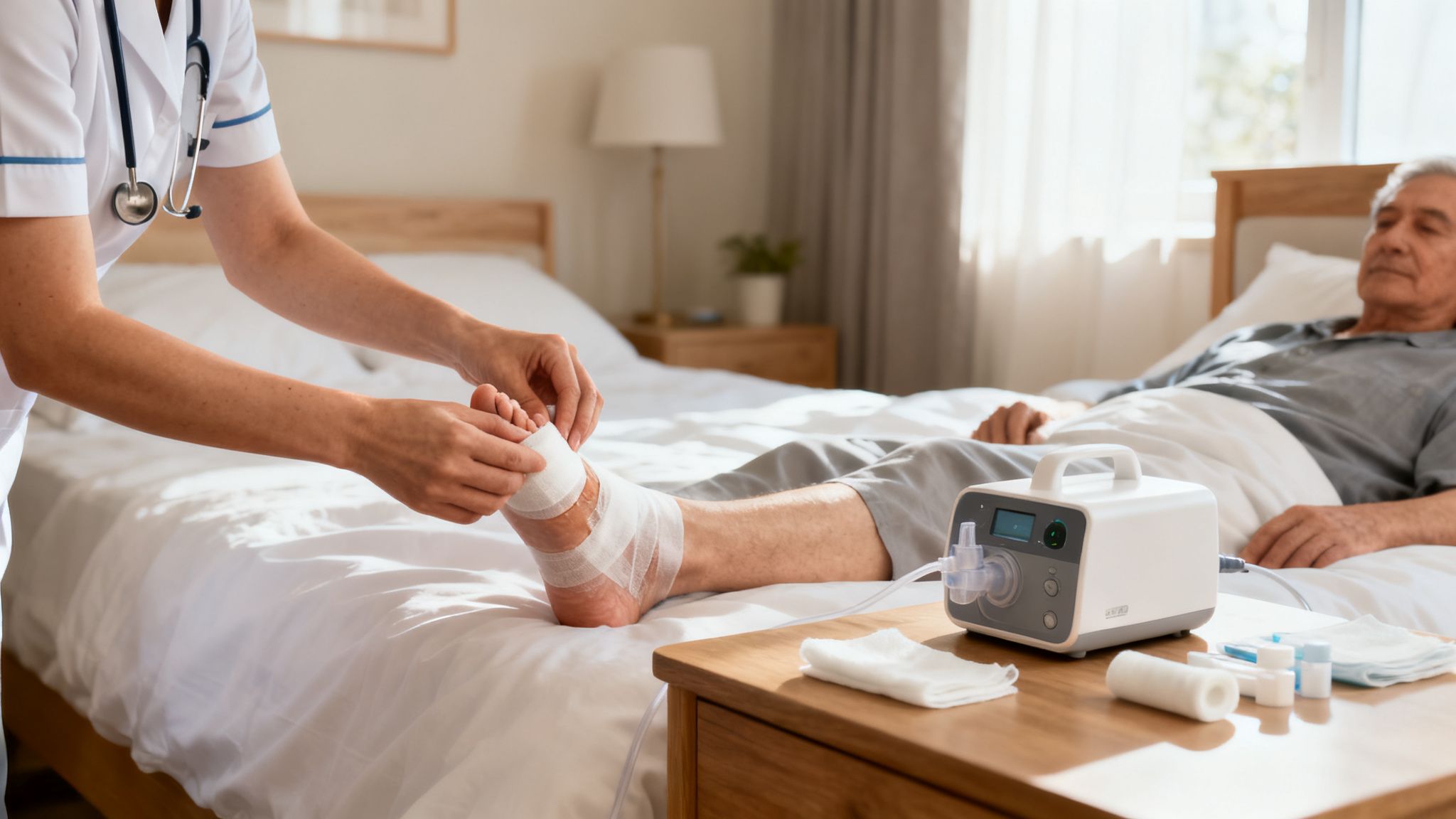
When you picture a private nurse at home, it’s easy to think of simple medical check-ins. But the reality is a whole lot broader. The support is designed to meet you where you are, blending sophisticated clinical skills with compassionate, practical help for daily life.
Understanding this full range is key. It helps families see how in-home nursing can do more than just manage an illness—it can genuinely improve quality of life and even prevent unnecessary hospital stays.
The best way to think about it is by splitting the care into two main categories: specialised clinical care and essential daily living support. A Registered Nurse (RN) takes the lead on the clinical side, but they often direct a team of skilled support workers who handle personal care. It's this collaborative approach that ensures every aspect of a person’s wellbeing is looked after.
Advanced Clinical Care
This is where you get hospital-level expertise brought right to your doorstep, all managed by a qualified and experienced RN. These services are vital for anyone dealing with complex medical issues, chronic conditions, or recovering from a major surgery.
It’s this level of medical know-how that really separates professional home nursing from basic home care.
Here are some of the most common clinical services a private nurse delivers:
- Complex Wound Management: This is far more than just changing a bandage. An RN might be managing a diabetic foot ulcer to prevent infection, caring for a surgical incision to ensure it heals properly, or treating stubborn pressure sores. The range of in-home nursing services is extensive, covering everything from personal care to highly specialised treatments like advanced home health wound care.
- Medication Management: Think administering injections, managing intravenous (IV) lines, or just making sure a complex medication schedule is followed to the letter. A practical example is a nurse managing an insulin pump for a person with type 1 diabetes, ensuring their blood sugar levels remain stable. For someone on multiple prescriptions, this kind of oversight is critical to avoiding dangerous mix-ups.
- Ventilation Support: A nurse can monitor and manage respiratory equipment like CPAP or BiPAP machines, which is especially important overnight. They make sure a person with sleep apnoea or respiratory weakness is breathing safely and comfortably while they rest.
- Catheter and Bowel Care: This covers the insertion, maintenance, and monitoring of urinary catheters and managing complex bowel care routines. These are delicate procedures that demand real clinical expertise to be done safely and hygienically.
A private nurse’s clinical skills are indispensable for managing chronic conditions at home, which is a significant and growing area of need. This proactive care model helps people maintain their health and avoid preventable hospital visits.
The demand for these services is growing fast in Australia. In 2023, the private nursing services market generated USD 134.2 million, and it's projected to climb to USD 201.1 million by 2030. Chronic disease management was the biggest piece of the pie, making up 32.27% of revenue, while post-operative care is the fastest-growing area—a clear sign of the vital role nurses play in recovery.
Personal and Daily Living Support
While the RN is focused on the clinical tasks, a truly great care plan also includes support for everyday activities. This kind of assistance is what helps a person maintain their independence, dignity, and a comfortable home life. These tasks are usually handled by highly trained support workers, all under the nurse's supervision.
This practical support lays the groundwork for better health outcomes. For instance, someone who gets help preparing meals is far more likely to eat nutritious food, which has a direct impact on their recovery and overall wellbeing. This holistic view is a core part of effective home health care.
Here’s what that personal support might look like:
- Mobility Assistance: Helping someone move safely around their home, transfer from a bed to a chair, or get out for a short walk. For example, a support worker might help a client recovering from a stroke with their daily exercises prescribed by a physiotherapist.
- Mealtime Support: Assisting people with dysphagia (swallowing difficulties) or those who simply need a hand with eating to make sure they get the right nutrition.
- Personal Hygiene: Providing respectful and dignified help with showering, dressing, and grooming.
- Companionship: Offering social interaction and emotional support, which is absolutely vital for mental and emotional health. This could be as simple as playing a game of cards or having a chat over a cup of tea.
Comparing Clinical and Personal In-Home Care
To make it even clearer, let's break down the two core types of support a private nurse and their team deliver. Understanding the difference helps you see how they work together to provide comprehensive at-home care.
| Type of Care | Services Included | Practical Example |
|---|---|---|
| Clinical Care | Medication administration (injections, IVs), complex wound dressing, catheter management, ventilator support, health monitoring. | An RN visits daily to clean and redress a post-surgical wound, check for signs of infection, and manage the patient's pain medication schedule. |
| Personal Care | Assistance with showering and dressing, meal preparation, mobility support, light housekeeping, companionship. | A support worker helps a client get ready for the day, makes them a nutritious breakfast, and ensures they can move safely from their bedroom to the living area. |
By combining these two streams of care, a private nursing team delivers a complete solution. It addresses both the medical and personal needs of an individual, allowing them to not just live, but thrive, in the comfort and safety of their own home.
How to Fund Your Private Nurse with NDIS
Figuring out how to use your National Disability Insurance Scheme (NDIS) plan to fund a private nurse at home can feel like you're trying to solve a complex puzzle. But it's simpler than it looks. The whole process boils down to one thing: showing that nursing care is a "reasonable and necessary" support that helps you live your life and reach your goals.
The NDIS is all about giving you choice and control, and that definitely includes managing your health from the comfort of your own home. Funding for a nurse isn't usually listed as a single line item. Instead, the funds are drawn from specific budgets already in your plan.
Most often, these services are paid for using your Core Supports budget, specifically from the 'Assistance with Daily Life' category. In other situations, your Capacity Building funds might be the right fit, particularly from 'Improved Daily Living' or 'Improved Health and Wellbeing'. It all comes down to your unique needs and how a nurse's support helps you get where you want to go.
Understanding Which NDIS Budgets Apply
To get your funding approved, you need to draw a clear line between the nursing support you need and your specific, disability-related needs. The NDIS won't cover things the mainstream health system is responsible for, like a trip to the GP. What it will fund is the ongoing, hands-on support you require at home because of your disability. For instance, while the health system covers the cost of medication, the NDIS can fund a nurse to administer it if your disability prevents you from doing it yourself.
Here’s a quick look at where the funding usually comes from:
- Improved Daily Living (Capacity Building): This budget is often used for therapies or assessments. A great example would be funding a nurse to come in and train you or your support workers on how to manage a specific health task, like changing a PEG feeding tube.
- Improved Health and Wellbeing (Capacity Building): If you need help managing the health-related aspects of your disability, this budget is a strong contender. It's designed for exactly that, making it a great option for specialised nursing care.
- Assistance with Daily Life (Core Supports): This is the most common bucket for daily, hands-on nursing care. These tasks are seen as essential to helping you manage your personal care and stay safe at home.
The main idea is to clearly explain to your NDIS planner how having a private nurse helps you tick off your plan goals, whether that's becoming more independent, getting out into the community, or simply staying healthy and safe.
A Practical Example: Funding Tracheostomy Care
Let's make this real. Meet Alex, an NDIS participant who needs regular tracheostomy care to breathe safely. Without this specialised care at home, he’d be in and out of the hospital, which would make living an independent life almost impossible.
To get the right funding in his NDIS plan, this is the path Alex and his support coordinator took:
- Gather Strong Evidence: They started by collecting rock-solid medical documentation well before the plan review meeting. The star of the show was a detailed letter from Alex’s respiratory specialist, which explained in no uncertain terms that daily tracheostomy management by a nurse was critical to prevent life-threatening complications.
- Complete a Functional Assessment: Next, an Occupational Therapist did an assessment showing exactly how Alex's tracheostomy impacts his day-to-day life. The report made it clear that without a nurse's help, simple things like showering, sleeping, or leaving the house were just not safe for him.
- Link to NDIS Goals: In his planning meeting, Alex didn't just ask for a nurse; he connected that need directly to his goals. One of his goals was "to safely access my community for social activities." He explained that having a nurse manage his tracheostomy was the only way he could do this with confidence.
- Request Specific Funding: Finally, they made a specific request for funding under 'Assistance with Daily Life' (Core Supports) to cover the hours of nursing care he needed each day. They backed this up with a quote from a provider, so the numbers were clear.
By presenting clear, specialist-backed evidence that links the nursing support directly to safety, independence, and personal goals, you build a powerful case for why this is a reasonable and necessary support under the NDIS.
Breaking it down like this turns a big, intimidating process into a series of manageable steps. To get even more prepared for your meeting, have a look at our detailed guide to NDIS in-home care for more practical tips and tools.
Choosing the Right Private Nursing Provider
Picking a private nursing provider is one of the most important decisions you'll make for your family. This isn't just about hiring a service; you're inviting a trusted professional into your home to care for someone you love. The choice deserves careful thought, some homework, and asking the right questions to find a provider that is both clinically excellent and genuinely compassionate.
It can feel like a huge task, but breaking it down makes it much more manageable. If you focus on a few non-negotiable standards, you can sift through the options with confidence and find a team that’s truly invested in your family’s well-being.
Your Essential Provider Checklist
Before you pick up the phone, get clear on what you’re looking for. Think of this as your baseline for safety and quality. Any reputable provider should have no problem ticking every box on this list.
Here’s what you absolutely need to verify:
- NDIS Registration: If you’re using NDIS funding, the provider must be a registered NDIS provider. This is your assurance that they meet the strict quality and safety benchmarks set by the NDIS Commission.
- Clinical Governance Protocols: Ask them to explain their clinical governance framework. A practical example is asking how they handle medication errors or patient complaints—their answer will reveal the strength of their safety systems.
- Qualified and Diverse Team: A top-tier provider won’t just have one type of staff. They’ll have a mix of Registered Nurses (RNs) for complex clinical tasks and skilled support workers for personal care, ensuring all bases are covered.
- Insurance and Compliance: Make sure they hold all the necessary insurances, especially public liability and professional indemnity. This protects you, your loved one, and their staff.
When choosing a nurse, it's also smart to check that they're committed to their professional development, which includes keeping up with continuing education requirements for nurses. This ongoing learning is crucial for staying current with the latest medical practices and ensuring the best possible care.
Practical Scenario: Seizure Management at Home
Let’s put this into a real-world context. Imagine a family needs a private nurse at home for their teenage son, who lives with a complex seizure disorder. They need more than just an emergency response; they need someone who can help manage his daily life to minimise seizure triggers.
In this case, a general nursing degree isn't enough. The family has to dig deeper to find a provider with specific, proven expertise in epilepsy and seizure management.
Finding the right provider means matching their specific clinical strengths to your unique care needs. For complex conditions like seizure management, generic experience isn't enough—you need proven expertise.
The demand for private nursing in Australia is on the rise, which means families have more options than ever. But it also means it’s more important to choose established, high-quality providers. Workforce data shows that while nurse retention in aged care has levelled out, the private sector remains a major employer for both Registered and Enrolled Nurses. This makes specialised providers like Core Nursing Solutions key players in delivering skilled care directly to the home.
Key Questions to Ask Potential Providers
Once you have your checklist and a clear picture of your needs, it's time to start interviewing potential providers. The way they answer these questions will reveal a lot about their professionalism and their approach to care.
- Staff Training and Competency: "What specific training do your nurses and support workers have in seizure management and emergency response?"
- Emergency Procedures: "Can you walk me through your exact protocol if my son has a seizure? Who is contacted, and in what order?"
- Client-Provider Communication: "How will we stay in touch with our primary nurse and the wider care team? Is there a communication log or a digital app we’ll use?"
- Care Plan Collaboration: "How will you involve our family, our son, and his neurologist in creating and updating his care plan?"
Asking pointed questions like these moves the conversation beyond a sales pitch. It forces providers to show you their processes, their expertise, and, most importantly, how they’ll partner with your family. This is how you find more than just a service—you find a genuine partner in care. To learn more about what to expect, you can also explore our detailed guide on Sydney-based home care services.
Your Onboarding Journey: What to Expect
Bringing a private nurse at home into your life is a big step, and it's completely normal to feel a mix of hope and apprehension. We get it. That’s why our process is designed to be clear, collaborative, and reassuring right from the start.
To give you a real sense of how it works, let's follow the story of a client we'll call David, who needs help with ventilation support at home. His journey shows how each step is carefully planned to build trust and create a care plan that genuinely fits his life.
The First Phone Call and Initial Chat
It all starts when David's support coordinator gives our team a call. This first conversation isn't a high-pressure sales pitch; it's a relaxed, no-obligation chat to understand the situation. We ask about David's main health needs—in this case, overnight ventilation support—and what he and his family are looking for from in-home nursing.
Our main job here is to listen. We want to hear about David’s routine, his personal preferences, and any worries his family might have. This initial talk helps us see if we're the right fit and sets the stage for the next crucial step.
In-Home Assessment and Goal Setting
A few days later, one of our senior Registered Nurses (RNs) visits David in his own home. This is much more than a clinical tick-and-flick exercise. It’s a chance to understand his world—how he gets around, where his equipment is, and what a typical day looks like for him.
During this visit, the RN works alongside David to map out his goals. He shares that he wants to feel safe enough to be home alone for short periods and to have enough energy to get to his weekly social club. These aren't just small wishes; they become the very heart of his care plan.
The process of finding the right provider always comes down to a few core principles: checking the fundamentals, asking the right questions, and ensuring a good personal fit.
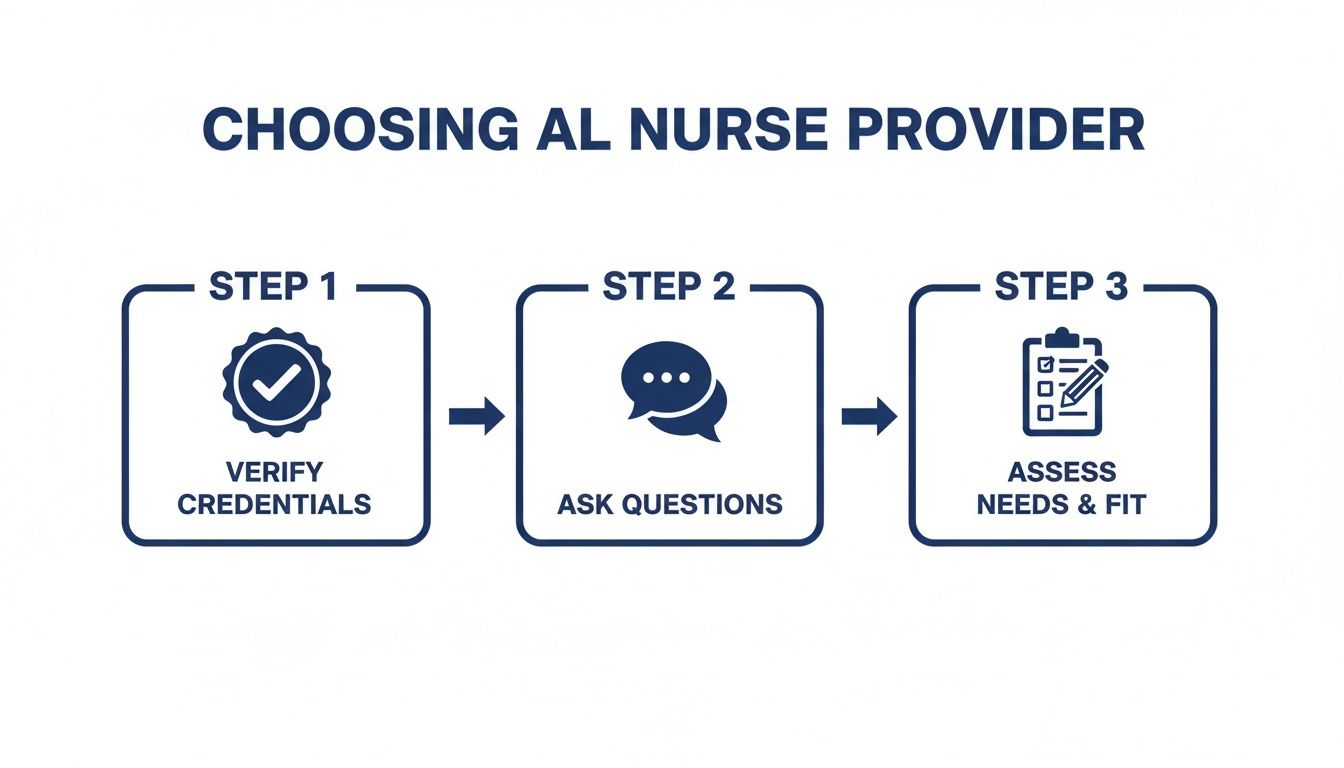
This visual guide highlights that taking a thorough, step-by-step approach is the best way to make sure the provider you choose is perfectly aligned with what you need.
Collaborative Care Planning
Next up is the care planning session. This is a real team effort. We bring together David, his family, our RN, and even his GP (via teleconference) so that everyone who matters has a seat at the table.
Our RN will present a draft plan based on the assessment, detailing the specific nursing tasks needed to manage David's ventilator, monitor his health, and help with his morning routine. This is where the collaboration really shines. David’s family adds important notes about his preferences, and his GP gives clinical oversight, making sure the plan fits seamlessly into his broader medical care.
This collaborative approach is non-negotiable for us. The best care plans are created with you, not just for you. They must reflect your personal choices and lifestyle, not just your clinical needs.
Finalising the Service Agreement
With the care plan agreed upon by everyone, the final piece of the puzzle is the service agreement. This document lays everything out in black and white: the exact services we'll provide, the schedule, the costs, and the rights and responsibilities of everyone involved. It’s written in plain English to make sure there are no surprises down the track.
You can get a better idea of what a good agreement includes in our guide to the NDIS service agreement template.
Once the agreement is signed, David's care team is officially ready to go. We introduce him to his primary nurse, and the first visit is scheduled. For David and his family, this transparent, person-centred journey turns uncertainty into confidence, giving them the peace of mind that comes with knowing he is safe and supported at home.
Partnering for Health and Independence at Home
Bringing a private nurse into your home is a big step—and a powerful one. It’s about taking back control of your health and your life, moving away from stressful, reactive hospital visits towards proactive care where you’re most comfortable.
This is about so much more than just ticking off medical tasks. It’s about building real independence, making sure you’re safe, and protecting your dignity, day in and day out. Having that expert clinical support right at your doorstep lifts a huge weight off family carers and often helps avoid those draining hospital stays altogether.
Taking the Next Step Towards Better Health
With the right support, you or your loved one can do more than just get by—you can truly thrive. It’s a partnership focused on hitting your own personal goals, whether that’s staying involved in your community or simply enjoying a higher quality of life at home. A good care plan looks at the whole picture: your clinical needs and what you actually want out of life.
By putting independence and well-being first, in-home nursing gives people the power to live a fuller life on their own terms, backed by professional, compassionate care.
This is especially crucial for anyone managing ongoing health issues. You can learn more about how a dedicated nurse can help with chronic condition management to keep things stable and sidestep potential problems.
At the end of the day, deciding to work with a private nursing service is an investment in your health, your comfort, and your peace of mind. We always encourage you to get in touch for a chat to see how a personalised in-home nursing plan can help you reach your health and lifestyle goals.
Got Questions? We’ve Got Answers
Stepping into the world of in-home nursing care can feel a little overwhelming, and it's natural to have a lot of questions. We get it. Here are some of the most common things families and support coordinators ask us when they're thinking about bringing a private nurse at home.
How Quickly Can We Get a Private Nurse Started?
When you need help, you often need it now. That's one of the biggest concerns we hear, and the good news is that arranging private care is usually much faster than navigating the public system. Typically, we can go from your first phone call to having a nurse at your door within a few days to a week.
Of course, the exact timing depends on how complex the care is and how urgent the situation feels. For example, if a client is being discharged from the hospital after surgery, we work closely with the hospital discharge planner to ensure a nurse is ready for the very first day they are home. It starts with a conversation to understand your needs, followed by an in-home assessment. Once we’ve finalised the care plan and service agreement together, support can begin.
Is 24/7 Nursing Care Possible at Home?
Absolutely. For people with high-acuity needs, around-the-clock nursing care is a genuine option. We tailor the level of support to fit the person perfectly, whether that means a scheduled daily visit or continuous, 24/7 care.
For instance, someone might only need a nurse for a few hours a day to manage medications and handle a complex wound dressing. On the other hand, a person who depends on overnight ventilation (like BiPAP or NIV) needs a nurse to be right there, awake and alert, to ensure their safety all night. In these cases, we build a dedicated roster of nurses to provide seamless coverage.
Continuous care is what makes it possible to safely manage even the most complex medical needs at home. For families, it offers incredible peace of mind, knowing a clinical expert is always on hand.
This level of support is often the key to avoiding hospital stays, allowing people to remain in the comfort and familiarity of their own homes, surrounded by family.
What Happens If Our Main Nurse Is Sick?
We know how important consistency and trust are in a care relationship. That’s why we have a solid backup plan to ensure your care is never interrupted, even if your primary nurse is unwell or takes a well-deserved break. You will never be left without support.
Before a different nurse steps in, they are given a comprehensive handover. They'll be fully briefed on your specific care plan, your daily routine, and your personal preferences. For instance, they would be told that the client prefers their medication with apple juice, not water, and likes to have the blinds opened first thing in the morning. We make sure they have all the clinical information they need to understand your goals. This preparation ensures the transition is smooth and the high standard of care you rely on is always maintained.
How Do Your Nurses Work with My Other Doctors?
Great question. Collaboration is the cornerstone of excellent in-home nursing. Our nurses become a vital link between your home and your broader healthcare team, making sure everyone is on the same page and your care is completely integrated.
Here’s a practical example of how we make that happen:
- Keeping Everyone in the Loop: After a client has a fall, our nurse provides a detailed incident report and progress notes to their GP and physiotherapist the same day.
- Joining the Conversation: Our nurses can take part in case conferences, either in person or through telehealth, to share valuable clinical insights from the home environment, such as noticing a new side effect from a medication.
- Managing Medications Safely: We work directly with your doctor and pharmacist to ensure your medication list is always current and managed safely.
This team-based approach ensures that the care provided by your private nurse at home slots in perfectly with your overall medical plan, leading to better health outcomes and a more connected support system.
Finding the right in-home nursing support can completely change your quality of life for the better. At Core Nursing Solutions Pty Ltd, we partner with you to create a care plan that puts your health, independence, and dignity first. Contact us to chat about how we can support you or your loved one at https://corenurses.com.au.