

Figuring out the cost of home care services in Sydney often feels like a tough question to answer. This is because the final price really does depend on your unique situation. The cost is shaped by the kind of support you need and the qualifications of the care professional. Another factor will be how often they’ll be visiting. Whether you fund your care privately or through a government program like the NDIS also makes a big difference to your out-of-pocket expenses.
What You Can Expect to Pay for Home Care Services in Sydney
When you start looking into in-home support, one of the first questions on your mind is always, “What will this cost?” While there isn’t a one-size-fits-all price list, getting to know the basic factors that influence cost is the best way to set a realistic budget for your family.
You can think of it like building a custom home. The final cost depends on the quality of the materials, the expertise of the builders, and how complex the design is. The same logic applies to home care. For example, needing a support worker for a few hours a week for companionship and light housekeeping will have a very different cost structure compared to requiring a Registered Nurse for daily complex medical procedures.

In Sydney, there are two main paths to securing care. The first is through a government-funded program, such as the National Disability Insurance Scheme (NDIS). This scheme is specifically designed to support Australians who have a permanent and significant disability.
The second option is private paying clients who self-fund home care services. This route offers the most flexibility and is a common choice for those who might not be eligible for government funding. Additionally, some people may wish to add more support on top of their existing plan.
At Core Nursing Solutions, we help families navigate both options. Ultimately, we are here to make sure you find a solution that lines up with your clinical needs and financial situation. In addition, our deep experience in providing comprehensive disability home care services means we create personalised plans that deliver meaningful value.
Key Factors Shaping Your Quote
To give you a clearer picture, the final cost of home care services comes down to a few core components. Whereas each component directly impacts the level of expertise and resources needed to provide safe and effective support at home.
Many Australians will need long-term care services at some point. Care supports such as assistance with dressing, bathing, or managing complex medication regimens are often requested. Understanding the cost is the first step toward preparing for these needs to ensure you can receive support in the comfort of your own home.
Here are the main things that will determine your final quote:
- Type of Service Required: Are you looking for personal care, like help with showering and dressing? Or do you need more complex clinical tasks, like wound management or ventilation support? For instance, a two-hour visit for personal care will cost less than a two-hour visit that includes administering intravenous medication.
- Professional Expertise: The price will change depending on whether you need a skilled support worker, an Enrolled Nurse (EN), or a university-qualified Registered Nurse (RN).
- Frequency and Duration: Is support needed for just a few hours each week, daily visits, or is round-the-clock 24/7 care required? A daily two-hour visit will have a lower weekly cost than 24/7 live-in care.
- Time of Service: It’s standard for rates to be higher for services on weekends or public holidays to account for staff penalty rates. For example, a visit on Christmas Day will be charged at a higher rate than the same visit on a regular Tuesday.
NDIS vs. Private Home Care Services Pricing
When you’re arranging care for yourself or a loved one, understanding how it’s all paid for is a huge piece of the puzzle. In Australia, the two most common ways to fund in-home care are through the National Disability Insurance Scheme (NDIS) or by paying for it privately. Indeed, the best one for your family really depends on your specific situation.
Think of it like choosing a mobile phone plan. On one hand, some people love a bundled plan where everything is included in a set structure. On the other hand, some people prefer a more direct, pay-as-you-go approach for total control over their spending. Both get you connected, but the process and payment structure are quite different.
How NDIS Funding Works
The NDIS is a government scheme designed to support Australians who have a permanent and significant disability. The funding you receive isn’t just a single pot of money. Rather, it is carefully organised into different support categories in your NDIS plan.
For clinical care at home, the most important category is usually your Core Supports budget.
This part of your plan is flexible and can be used to pay for help with daily living. This includes personal care and health-related support. To keep things fair and consistent, the NDIS sets price limits for different services. These are all laid out in the official NDIS Price Arrangements and Price Limits document. In particular, this document tells providers like us how much they can charge for their support.
To clarify, this means the home care services cost is regulated and predictable for NDIS participants. When you receive services from a NDIS provider, they claim the payment for their services directly from your NDIS plan. However, they must not charge higher than the NDIS set rates.
A Practical NDIS Scenario
Let’s look at a real-world example. Meet John, a NDIS participant in Sydney who needs specialised wound care and help with his medication after a recent surgery.
- His Need: John needs a Registered Nurse to visit him three times a week. The nurse’s job is to change his wound dressing and give him a specific injection.
- His Funding: His NDIS plan has funding available under ‘Assistance with Daily Life’ in his Core Supports budget.
- The Process: John’s family gets in touch with us at Core Nursing Solutions. We assess his clinical needs and confirm his NDIS funding can cover the nursing visits. We then draw up a service agreement that clearly outlines the schedule and costs, all aligned with the NDIS price limits. Our nurses provide the care, and we handle the billing by claiming the funds directly from John’s NDIS plan.
This structured process ensures John gets the expert clinical care he needs without his family having to worry about out-of-pocket costs. To see more about how we can help, you can explore our resources on finding a trusted NDIS provider in Sydney.
The Flexibility of Private Pay
The other option is to pay privately. This is a great choice for anyone who isn’t a NDIS participant, or a NDIS participant who wants to add extra services on top of their current government funding. Alternatively, a NDIS participant may choose to self-fund their home care services and invoice the NDIS themselves.
When you pay privately, you receive an invoice for the care provided and pay the provider from your own funds. This approach gives you complete control to customise the services you receive. This is because you aren’t tied to the specific price caps of a government program.
Key Takeaway: Private pay offers maximum flexibility. You get to decide the exact type, frequency, and length of care you want. Plus, you can often get services started much faster since there’s no need to wait for funding approvals or plan reviews.
This direct model is perfect for people who need support right away or require services that might not be covered by their existing funding package. For example, a person named Sarah might have a government-funded NDIS plan for general daily support but suddenly needs overnight monitoring for a week after a hospital stay. Thus, she could choose to privately fund a private nurse for the short-term without having to go through a lengthy funding reassessment.
Why Some Home Care Services Cost More Than Others
Have you ever looked at a quote for home care services and wondered what actually goes into the hourly rate? It’s a fair question. The price isn’t just a number pulled out of thin air. Moreover, it’s a direct reflection of the skill, responsibility, and intensity needed to provide safe and effective support. Understanding these factors is the key to seeing the true value behind the home care services cost.
A good way to think about it is to compare it to fixing a car. Changing a flat tyre is a pretty straightforward job that needs basic tools and know-how. But rebuilding an entire engine? That’s a highly complex task demanding a specialist mechanic with years of training and advanced equipment. It’s only natural that the prices for these two jobs would be very different.
The same idea applies to home care services. A support worker helping with daily errands and companionship provides an absolutely essential service. Yet their role is fundamentally different from a Registered Nurse managing complex tracheostomy care or administering intravenous medication. The level of clinical risk, training, and critical thinking involved is on a completely different scale.
Care Acuity: The Main Cost Driver
The single biggest factor that shapes the cost is care acuity. It’s an industry term, but it simply means how complex and intense a person’s medical needs are. High-acuity care involves tasks that carry significant risk if done incorrectly, demanding specialised clinical judgment. Low-acuity care, while just as important for a person’s wellbeing, involves far less medical risk.
Here’s how acuity plays out in real-world scenarios:
- Low Acuity Example: Assisting an elderly gentleman named David with his weekly grocery shopping, preparing light meals, and providing companionship during the day. This is typically handled by a skilled Support Worker.
- Moderate Acuity Example: Helping a client named Maria, who uses a wheelchair, with safe transfers from her bed to her chair and administering pre-packaged morning medications. This might be managed by an experienced support worker or an Enrolled Nurse (EN).
- High Acuity Example: Managing a home ventilator for a young child, providing complex post-surgical wound care for an adult, or administering injectable medications. These tasks legally and ethically require the expertise of a Registered Nurse (RN).
Because RNs have extensive university education and advanced clinical skills, they command a higher hourly rate. This isn’t just about paying for a qualification. Rather, it’s about ensuring the health and safety of the person receiving care.
Professional Expertise and Service Duration
The professional’s qualifications are directly tied to the cost. In Australia, the price for in-home care can vary quite a bit based on the clinical support required. As of 2026, nursing care commands higher rates, with the cost to have a registered nurse for a daytime during a weekday start at AUD 123 per hour. For our clients in remote or rural areas, the cost price is higher. Hence, Core Nursing Solutions uses a combination of support workers and registered nurses to keep your costings in budget.
The level of professional expertise needed is the primary determinant of the hourly rate. You are paying for the peace of mind that comes with knowing a qualified and experienced professional is managing critical health tasks safely.
The timing and duration of the service also play a big part. Consistent, round-the-clock care (24/7 support) will naturally have a higher total cost than a few visits each week. Likewise, services needed on public holidays or weekends come with higher staff penalty rates, and that gets reflected in the price.
The infographic below shows the two main funding streams that families use to manage these costs.
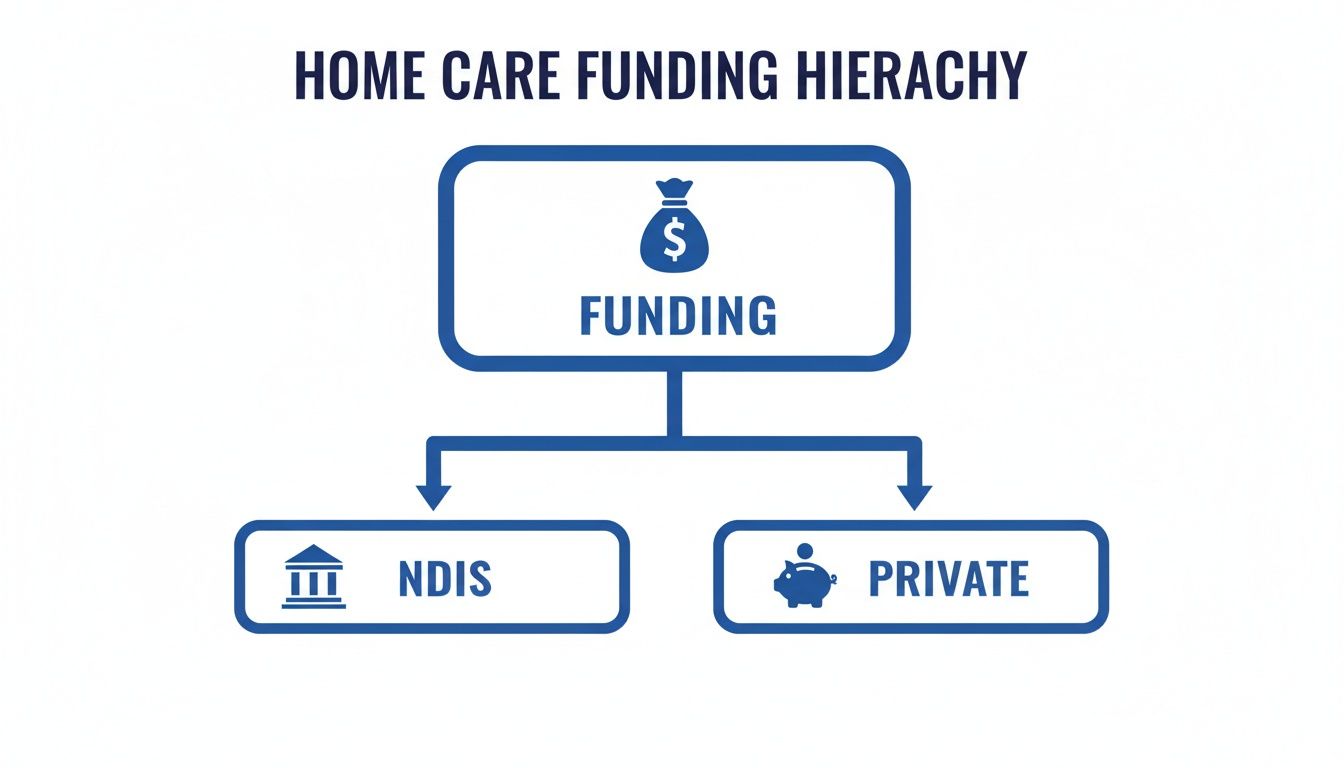
Whether you use government funding like the NDIS or pay privately, the things that drive the cost is acuity and professional skill. The funding source just determines who is paying the bill. At Core Nursing Solutions, we are experts in delivering high-acuity support and can help you understand how our specialised in-home nursing services align with your specific clinical needs.
Typical Price Ranges for Sydney Home Care Services
Knowing what drives the home care services cost is one thing, but seeing real numbers makes everything click into place. To help you and your family plan with confidence, let’s look at some illustrative price ranges for common in-home services you’ll find around Sydney.
Think of these figures as a realistic guide. They’ll make it much easier to compare quotes and understand the true value of the support you’re receiving. Of course, the final cost will always be tailored to specific clinical needs, the type of professional required, and the timing of the support.

A Snapshot of Sydney Home Care Services Rates
To make these costs more tangible, let’s break down some typical hourly rates you might come across.
This table shows different levels of care, the professional who usually provides the service, and a common weekday price range.
Illustrative Hourly Rates for Home Care Services in Sydney
Note: These are estimates and your final quote will depend on individual needs.
| Service Type | Typical Professional | Estimated Weekday Hourly Rate (AUD) |
|---|---|---|
| Personal Care & Daily Support | Disability Support Worker | $65 – $80 |
| Standard Nursing Care | Enrolled Nurse (EN) | $90 – $120 |
| Complex Clinical Nursing | Registered Nurse (RN) | $120 – $180+ |
As you can see, there’s a clear link between the price and the level of clinical skill involved. A support worker provides vital help with daily life, while a Registered Nurse handles complex medical tasks that demand years of training and qualifications.
It’s about matching the right professional to the right need.
Understanding Price Variations in Home Care Services
You’ll also find that rates change depending on when the service is delivered. This is standard practice right across the healthcare industry, and it’s tied directly to fair compensation for staff.
- Weekend Rates: Expect to pay more for services on a Saturday or Sunday.
- Public Holiday Rates: These are usually the highest rates, reflecting penalty wages for staff.
- Overnight Shifts: Active overnight care (where the professional is awake and working) is priced differently from inactive “sleepover” shifts.
For example, a standard weekday visit from an RN for complex wound care might cost $120 per hour. That same service on a public holiday could be quite a bit higher. This ensures skilled professionals are fairly compensated for their time and are available to provide critical care whenever you need it most.
When you’re comparing quotes, always ask for a full schedule of rates. Make sure it includes weekday, weekend, and public holiday prices. This simple step prevents any surprises down the track and helps you build a complete budget.
Government Reforms and Pricing Transparency
The way providers structure their pricing has been changing. The move towards Australia’s new NDIS reform has shifted how home care services pricing works. As a result, making things clearer and more accessible for everyone.
As of 24 November 2025, many changes in service rates were updated in the new pricing agreement. You can explore a detailed breakdown of these changes to see how the system has become more transparent for families like yours.
How to Secure Funding for Your Home Care Needs
Figuring out the costs of home care is one thing, but the next step is actually getting the financial support you need. For many, navigating government funding can feel like a maze. However, with a bit of guidance, you can absolutely access the support you’re entitled to.
For those with a NDIS plan, this guide gives you a clear path forward. Think of it as a roadmap that is showing you exactly how to get your care funded.
Accessing NDIS Funding Step by Step
The National Disability Insurance Scheme (NDIS) is the main government program for Australians who have a permanent and significant disability. Getting NDIS funding is a structured process, and being well-prepared from the start makes a huge difference.
Here’s what you’ll need to do:
- Check Your Eligibility: Firstly, head over to the official NDIS website. You need to make sure you meet the requirements for age, residency, and disability. The key is that the disability must be permanent and significantly affect your ability to handle everyday activities.
- Gather Your Medical Reports: This is probably the most important part of your application. You’ll need reports and assessments from your doctors and specialists. For example, if you need in-home nursing for managing a PEG feed, you will need a report from your gastroenterologist detailing the medical necessity of this support. These documents must clearly diagnose your condition and explain in detail how it impacts your day-to-day life. Strong evidence is your best friend here.
- Submit Your Access Request Form: With all your documents in hand, you can fill out and send in the NDIS Access Request Form. This is what officially begins your journey with the scheme.
- Prepare for Your Planning Meeting: If your request is approved, you’ll be invited to a planning meeting. This is your chance to talk about your goals and what support you need to achieve them, like in-home nursing. Be really clear about what you need. For instance, instead of saying “I need help with my health,” you could say, “I need a Registered Nurse for one hour every morning to administer my insulin injection and check my blood sugar levels.”
Getting this process right ensures your plan has enough funding for essential services, like our expert support for assistance with daily life activities.
Understanding Aged Care Funding
For older Australians, the main funding pathway is My Aged Care, which gives you access to Home Care Packages (HCPs). These packages are all about helping you live independently in your own home for as long as possible.
Securing the right funding isn’t just about filling out forms. It’s about clearly communicating your needs and goals. A well-prepared application ensures your funding package accurately reflects the level of support required for your health and wellbeing.
Unlike the NDIS, getting a Home Care Package involves a means test. This means your income and assets are looked at to figure out how much you might need to contribute towards your care costs. This contribution is called an income-tested care fee.
For those who get government-subsidised Home Care Packages, the funding can range from AUD 10,687 for basic Level 1 support right up to AUD 62,014 for high-level Level 4 packages. However, your personal out-of-pocket costs will depend on your financial situation.
Getting a Transparent Quote from Core Nursing Solutions
Understanding what goes into the cost of home care is the first step. The next is getting a clear, personalised quote that reflects your specific situation. To make this process as smooth as possible, it helps to have a few key details ready when you reach out to us. This way, we can build an accurate picture of your needs right from the start.
Think of it like preparing for a new doctor’s appointment. The more information you can share about your history and current condition, the better they can plan your treatment. The same idea applies here, the more we understand, the more precise your care plan and quote will be.
What to Have Ready
To help us give you a transparent and accurate quote, gathering a few key documents beforehand is incredibly useful. This preparation gives our clinical team a clear understanding of the specific support you require.
- Your NDIS Plan: If you’re an NDIS participant, having your current plan handy is essential. It tells us which support categories are funded and the budget available for your nursing and personal care.
- A Summary of Clinical Needs: A quick overview of the required medical tasks is very helpful. This might include details on wound care, medication schedules, or specialised equipment like ventilators or feeding tubes. For example, a note saying “Requires daily complex wound dressing changes on the left leg” is much more helpful than just “needs help with a wound.”
- Relevant Medical Reports: Any recent hospital discharge summaries or reports from specialists provide the clinical context we need to plan safe and effective care.
The Assessment and Quoting Process
Once we have the initial information, we start a process that’s both thorough and collaborative. It begins with a detailed assessment, conducted by one of our Registered Nurses. This is to fully understand your goals and clinical requirements.
Based on this assessment, we create a detailed care plan and a fully itemised quote. There are no hidden fees, every cost is clearly laid out so you know exactly what to expect. This quote will break down the type of professional required for each task and the associated hourly rates for weekdays, weekends, and public holidays.
A provider’s service agreement is a critical document. It outlines every aspect of your care, from the schedule of services to the costs involved. It’s there to protect both you and the provider by creating a clear, mutual understanding from day one.
Before any services begin, we’ll walk you through a service agreement. If you’d like to see what this looks like, you can view a standard NDIS service agreement template to familiarise yourself with the structure.
Ready to take the next step? Contact our friendly team at Core Nursing Solutions today for a no-obligation chat. We’re here to answer your questions and help you build a care plan that supports your health, independence, and wellbeing at home.
Your Questions About Home Care Services Cost
Working out the financial side of home care services can feel overwhelming. We get it. To make things clearer, we’ve answered some of the most common questions we hear from families in Sydney looking into the cost of home care.
Our goal is simple: to give you the confidence that comes from understanding all the details.
Are Travel Costs for Nurses Included in the Hourly Rate?
That’s a great question, and it often depends on the provider. At Core Nursing Solutions, we believe in being completely upfront with our pricing. For this reason, every quote we provide will clearly list out each cost.
For example, your quote might show an hourly rate for the service itself, and then a separate line item for “Provider Travel” if the nurse is travelling from one client to another. We’ll show you whether travel time is already part of the hourly rate or if it’s billed separately, following NDIS guidelines. When we chat, we’ll go through this breakdown together so there are absolutely no surprises later on.
What Happens If Our Care Needs Become More Complex?
It’s completely normal for health needs to change over time. A good care plan is never set in stone. It should be flexible enough to grow with you. Especially if a person’s condition changes and they need a higher level of support. For instance, if a participant has a decline in health and they now require overnight monitoring. In this case, a full reassessment is commenced to get you the support you need.
A proactive care provider doesn’t just react to changes. Rather, they anticipate them. Regular reassessments are key to ensuring the care plan remains safe, effective, and aligned with the individual’s current health status and goals.
This is a team effort involving you, your family, and your medical team to officially update the care plan. If you are a NDIS participant, we’ll also support you in preparing for a plan review to ask for the extra funding needed to cover more complex care.
Can I Use My NDIS Funding for In-Home Nursing Care?
Yes, absolutely. The NDIS is designed to fund reasonable and necessary supports that relate to a person’s disability, and that very often includes their health needs.
If you need specialised nursing care at home for things like managing medication, wound care, or help with ventilation, you can use the funding in your plan. Usually, this funding comes from your Core Supports or Capacity Building budgets to pay for services from a registered NDIS provider like us. For example, a person with diabetes may not be able to administer their insulin due to their disability. In this case, they can use NDIS funding to have a nurse visit and administer their insulin injections.
What’s the Difference Between a Registered Nurse and an Enrolled Nurse?
It’s helpful to understand the different nursing roles, as this explains why their rates are different. A Registered Nurse (RN) has a university degree in nursing. They are qualified to handle complex clinical tasks, carry out detailed health assessments, and create care plans. For example, an RN is needed to manage a tracheostomy or adjust complex medication doses based on a doctor’s orders.
An Enrolled Nurse (EN) holds a diploma of nursing and provides essential nursing care but works under the supervision of an RN. An EN might handle tasks like administering routine medications or performing simple wound dressings. The hourly rates for each reflect this difference in qualifications, what they are able to do, and their level of clinical responsibility. As a result, RN services have a higher cost.
Ready to get a clear and transparent quote based on your unique needs? The team at Core Nursing Solutions Pty Ltd is here to help you understand every aspect of your home care services cost. Contact us today for a no-obligation consultation to see how we can support you.