
NDIS reportable incidents are when something goes wrong during NDIS service delivery, it’s not just an accident. These are serious events, or even alleged events, that cause harm to a participant. A reportable incident is defined as a specific act or event involving an NDIS participant that must be reported to the NDIS Quality and Safeguards Commission. Registered NDIS providers have a legal duty to navigate these situations carefully, not to point fingers, but to ensure safety and quality care for everyone.
Defining NDIS Reportable Incidents

It’s helpful to think of the NDIS reportable incidents framework as a safety and learning tool, not a punishment system. The main goal isn’t to assign blame. Instead, it creates a transparent way to understand what happened, protect the participant, and make sure it doesn’t happen again. This process keeps both the provider and participant safe by building a culture of continuous improvement and well-cared for support.
For example, if a participant with mobility issues has a serious fall during a support session and fractures their hip, that’s a reportable incident. The investigation that follows goes deeper than just the fall itself. Hence, a deeper enquiry prompts crucial questions. Was the support worker properly trained in safe manual handling? Did a home risk assessment completed to identify trip hazards? How current was the participant’s mobility plan? Answering these questions helps fix the root cause.
Prevention as the First Line of Defence
Of course, the best outcome is to prevent incidents from happening in the first place. A majority of incidents can be avoided when staff are well-trained, and providers follow Work Health and Safety (WHS) laws. When a provider invests in ongoing staff education, conducts thorough risk assessments, and fosters a culture of safety, they create a much safer environment for participants. Indeed, this preventative mindset is at the heart of quality care.
A proactive approach to safety, grounded in thorough staff training and adherence to WHS standards, is the most effective strategy for minimising risks and ensuring participants can live with dignity and security.
How Incident Reporting Works
The NDIS Commission sorts reportable incidents into specific categories, each demanding a clear and timely response. When an incident occurs, a provider must navigate it by following a clear process:
- Ensure Immediate Safety: The participant’s wellbeing is always the first priority.
- Report to the Commission: Strict deadlines apply. The most serious events need to be reported within 24 hours.
- Investigate Thoroughly: The provider must conduct their own internal investigation to figure out what happened and why.
- Implement Preventative Strategies: Based on the investigation findings, management must implement preventative strategies—like new training, updated risk assessments, or revised care plans—to stop it from recurring.
This structured process turns every NDIS reportable incident into a learning opportunity. It strengthens safeguards and ultimately makes the entire NDIS system safer for everyone.
Categories of NDIS Reportable Incidents at a Glance
To make it clearer, here’s a quick summary of the main types of incidents that must be reported to the NDIS Commission. Each class of incident highlights a different area of risk, and understanding them helps providers identify and respond correctly.
| Incident Category | Brief Description |
|---|---|
| Death of a person with a disability | The death of an NDIS participant, regardless of whether it occurred during service delivery. |
| Serious injury of a person with a disability | An injury that requires medical treatment or significantly impairs the person’s daily activities. |
| Abuse or neglect of a person with a disability | Any form of physical, sexual, psychological, or financial abuse, as well as neglect. |
| Unlawful sexual or physical contact with, or assault of, a person with a disability | Includes sexual misconduct and any unlawful physical contact or assault. |
| Sexual misconduct committed against, or in the presence of, a person with a disability | Sexual misconduct by a worker towards a participant, including grooming. |
| Use of a restrictive practice in an unauthorised manner | The use of seclusion, chemical, mechanical, physical, or environmental restraints without proper authorisation or planning. |
Understanding these categories is the first step for providers to meet their obligations and, more importantly, to ensure the safety and wellbeing of the people they support.
Why NDIS Reportable Incidents are Essential for Participant Safety
At its heart, the entire NDIS reportable incidents framework is built on a single, foundational principle: safeguarding participants. This system creates a vital safety net, especially for people with complex health needs who count on consistent, high-quality support. It ensures when something goes wrong that it’s not just brushed aside.
When an incident is reported, it prompts a formal process. As a result, this makes sure any harm is addressed and the situation is investigated. Most importantly, that we learn from it to improve service. In the same way, every NDIS reportable incident gives us critical information to improve care standards across the board.
This process doesn’t just protect the person involved; it strengthens the entire NDIS community. Furthermore, incident reporting holds providers accountable by building a culture of honesty.
How Reporting Protects Everyone
A solid incident reporting system means providers aren’t just reacting to problems, but actively working to prevent them. It creates a clear pathway for dealing with and resolving issues, which keeps both the provider and the participant safe and well-cared for.
When a provider is committed to transparent reporting, it sends a strong signal about their dedication to quality and safety. Certainly, transparency builds trust with participants and their families, reassuring them that their wellbeing is the number one priority. In addition, transparent reporting also makes for a safer workplace for support staff by finding and fixing potential hazards.
The act of reporting an incident is the first step in a powerful cycle of improvement. It transforms a negative event into an opportunity to strengthen protocols, enhance training, and ultimately deliver safer, more reliable care.
A good incident management system shines a light on gaps in these areas before they lead to serious harm, showing just how important it is to be proactive about safety.
From Incident to Actionable Insights
Reporting is really just the beginning of an ongoing process of deeper enquiry. Once an incident is logged, it has to be properly investigated to figure out what really caused it. Because a provider’s responsibility goes far beyond just telling the NDIS Commission; they need to analyse why it happened and what systemic changes are needed.
For instance, if a participant has a fall during a transfer, the investigation shouldn’t stop at just documenting the injury. It would dig deeper, asking questions like:
- Was the support worker’s manual handling training up to date?
- Did the equipment, like the hoist, work correctly?
- When was the participant’s mobility care plan last reviewed and updated?
Based on these findings, management must put concrete preventative strategies in place. This could mean scheduling refresher training for all staff, updating equipment maintenance logs, or revising a participant’s care plan with their healthcare team. This structured response is central to providing safe and effective disability home care services. By turning insights into action, providers ensure that every incident, no matter how small, helps build a safer future for all participants.
Understanding the Classes of NDIS Reportable Incidents
To really get a handle on the NDIS framework for reportable incidents, you first need to know exactly what events count. The NDIS Commission has sorted these incidents into specific classes, and each one points to a serious breakdown in safety or care. Getting familiar with these terms isn’t about learning jargon; it’s about empowering everyone—participants, families, and providers—to spot a serious issue and act fast.
These aren’t just bureaucratic boxes to tick. They are vital tools for accountability and, more importantly, for preventing harm in the first place. Most incidents are avoidable when providers stick to strict WHS laws and hire experienced, well-trained staff. When something does go wrong, getting the classification right is the first step toward a proper investigation, figuring out what happened, and making sure it never happens again.
NDIS Reportable Incidents: Death of a Person with a Disability
The death of a person with a disability being cared for is the most serious class of incident. Consequently, such an incident must be reported to the NDIS Commission. To further, it doesn’t matter if the person passed away during active service or not. This rule underscores the deep duty of care providers have. In particular, ensures any underlying issues that might have contributed are brought to light and investigated.
NDIS Reportable Incidents: Serious Injury
A serious injury is any injury that needs professional medical attention from a doctor or nurse. Think of anything beyond what a basic first aid kit can handle—from a deep cut that needs stitches to a fall that results in a fracture.
For instance, a participant slipping in the shower and dislocating their shoulder. Evidently, this is a clear serious injury. Reporting it prompts a review of bathroom safety equipment (like grab rails and non-slip mats), the participant’s personal care plan, and the level of assistance provided, helping to prevent future accidents.
NDIS Reportable Incidents: Abuse or Neglect
This category is broad, covering any action—or failure to act—that causes harm to a participant. Abuse isn’t just physical; it can be emotional, sexual, or financial. Neglect is a failure to provide the basic care, support, or supervision a person needs, which then leads to harm or puts them at risk.
Reporting incidents is not merely to comply with regulatory requirements but to ensure appropriate investigation, response, and measures to prevent recurrence. It aims to enhance the quality and safety of care by identifying and addressing underlying issues.
For instance, if a support worker repeatedly fails to administer prescribed medication on time, leading to a decline in the participant’s health, this is a form of neglect. Likewise, if a worker uses a participant’s bank card without permission to buy personal items, that is financial abuse. Both are serious NDIS reportable incidents that require an immediate response.
NDIS Reportable Incidents: Unlawful Sexual or Physical Contact
This class covers any kind of illegal sexual contact or physical assault against a person with a disability. To clarify, it’s a wide-ranging category that includes everything from inappropriate touching to physical violence. Because these acts are “unlawful,” providers are generally required to report them to the police as well as the NDIS Commission.
NDIS Reportable Incidents: Sexual Misconduct
While it sounds similar to the above, sexual misconduct is a bit different. It specifically refers to improper conduct of a sexual nature from a worker towards a participant. This could include grooming behaviour, making suggestive remarks, or showing someone explicit material. It’s important to know that physical contact doesn’t have to occur for it to be a reportable incident.
NDIS Reportable Incidents: Unauthorised Use of Restrictive Practices
A restrictive practice is anything that limits a participant’s rights or freedom of movement. These practices, like locking a door (environmental restraint) or using medication to manage behaviour (chemical restraint), should only ever be a last resort. They must be part of a formal, approved behaviour support plan.
A classic example is a support worker locking the refrigerator to prevent a participant from accessing food. Regardless of if their intention was to manage a health condition. Consequently, if this action was not documented and authorised in a behaviour support plan, it is an unauthorised use of a restrictive practice and must be reported. The data shows just how big of an issue this is. In its first annual report, which only covered two states, the NDIS Commission received notifications for 1,618 incidents involving the unauthorised use of restrictive practices. You can dig deeper into this by reviewing the findings of the NDIS Commission’s annual report.
How Providers Navigate NDIS Reportable Incidents from Report to Resolution
When a reportable incident happens, a registered NDIS provider must pivot from routine care to a structured, time-sensitive response. Navigating an incident from the initial event to a final resolution takes precision, empathy, and a solid commitment to transparency.
The first priority is never paperwork—it’s always people. The provider’s immediate job is to ensure the safety and wellbeing of the participant involved. This might mean giving first aid, calling emergency services, or offering emotional support. Only once the person is safe does the formal reporting and investigation begin.
Critical First Steps: Investigation and Reporting
After ensuring the participant’s immediate safety, the provider needs to start an internal investigation. Think of this as a fact-finding mission, not an exercise in placing blame. The goal is to figure out exactly what happened, why it happened, and what underlying factors might have played a part.
At the same time, the clock starts ticking on reporting deadlines. For the most serious NDIS reportable incidents—like a participant’s death, serious injury, or abuse—providers must notify the NDIS Commission within 24 hours. This rapid alert ensures the Commission has immediate oversight.
For other reportable incidents, the provider has five business days to submit a more detailed report. These timelines create accountability and ensure a prompt response to potential harm.
This visual breaks down the core steps providers must follow, turning a complex process into a clear three-stage flow
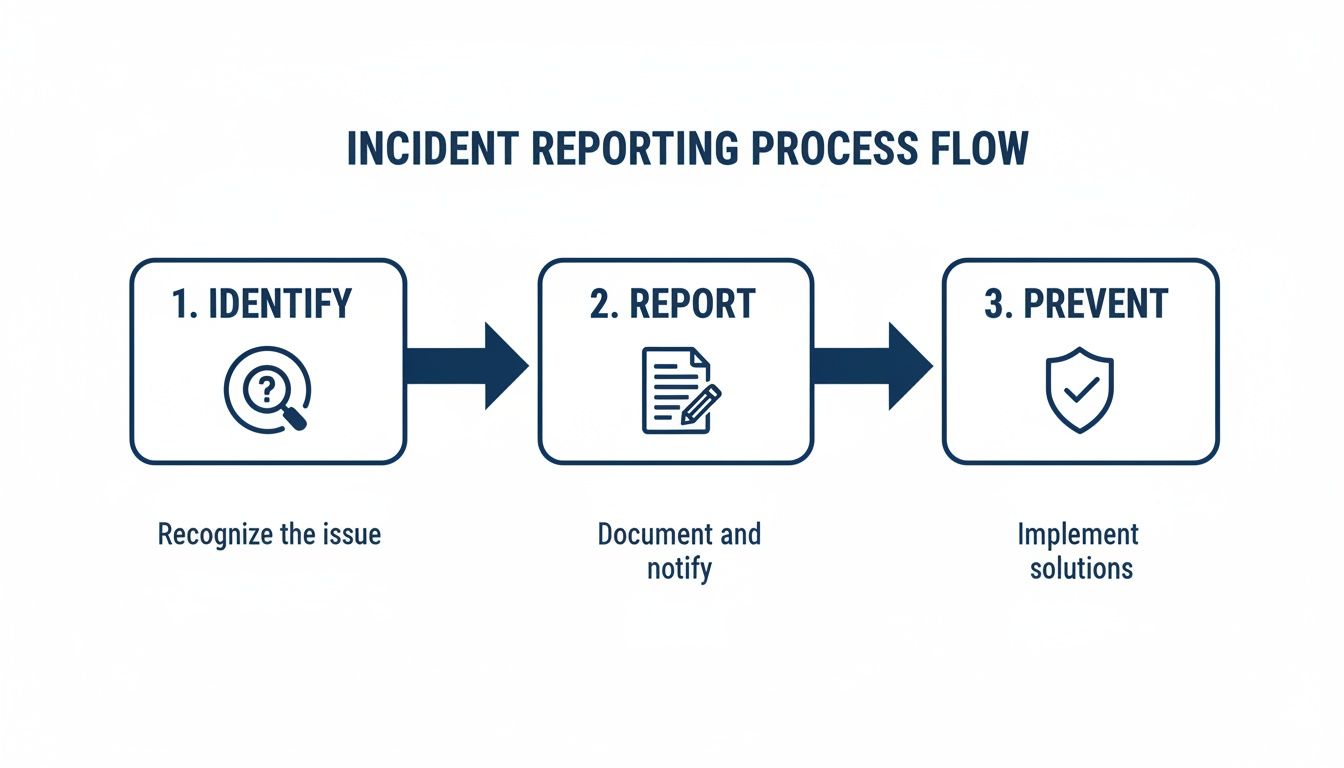
As you can see, reporting is just one piece of the puzzle. The real goal is to get to the root cause and put lasting preventative measures in place to keep all participants safe.
To keep everything clear, here’s a quick breakdown of the official timelines.
Incident Reporting Timelines for NDIS Providers
- The unauthorised use of a restrictive practice – Report within 5 business days of the provider becoming aware of the incident.
- The death of a person with disability – Report within 24 hours of the provider becoming aware of the incident.
- Serious injury of a person with disability – Report within 24 hours of the provider becoming aware of the incident.
- Abuse or neglect of a person with disability – Report within 24 hours of the provider becoming aware of the incident.
- Unlawful sexual contact or sexual misconduct – Report within 24 hours of the provider becoming aware of the incident.
- An incident reported to police (as required by law) – Report within 24 hours of the provider becoming aware of the incident.
Meeting these deadlines is non-negotiable and shows a provider’s commitment to the NDIS Quality and Safeguards Framework.
Implementing Preventative Strategies for Lasting Safety
A thorough investigation is only useful if it leads to real change. When the root cause of an incident is found, management must implement concrete preventative strategies. This is where a negative event becomes a powerful opportunity for genuine improvement.
These strategies have to be specific and actionable. For instance:
Incident: A participant gets a serious injury from a fall during a transfer.
Finding: The support worker used an outdated manual handling technique.
Strategy: Schedule mandatory refresher training on current best-practice transfer techniques for all support staff within two weeks.
Incident: A medication error happens, making a participant feel unwell.
Finding: The medication chart was confusing and hard to read.
Strategy: Management will implement a new standardised medication chart format and a mandatory double-checking protocol for all high-risk medications.
This proactive approach is essential. An incident often shines a light on a gap in these foundational areas, giving you a clear roadmap for what to fix.
An incident investigation should not be seen as the end of a process, but rather the beginning of a cycle of improvement. It provides the essential data needed to strengthen safeguards, refine care protocols, and foster a culture where safety is everyone’s responsibility.
Ultimately, this cycle of reporting, investigating, and improving ensures that both the provider and the participant are kept safe. It turns the incident management system from a reactive task into a proactive tool for delivering the highest standard of care. This commitment to continuous learning is what separates a quality provider from the rest, reflected in everything they do, including clear communication outlined in a well-structured NDIS service agreement template.
The Ever-Changing Rules for NDIS Providers
The National Disability Insurance Scheme is always being updated to better protect the people it serves. With the NDIS Commission looking closer than ever and new advice coming from the Disability Royal Commission, the goalposts for providers are constantly shifting.
This means that solid incident management is no longer just a box-ticking exercise. Rather, it is a true measure of a provider’s quality, their commitment to safety, and whether they’re built to last. For families, plan managers, and GPs, knowing how a provider handles NDIS reportable incidents is a huge part of choosing a service you can trust.
A Response to Closer Scrutiny
In recent years, the NDIS reportable incident rules have become stricter. This isn’t happening out of the blue; it’s a direct response to the community demanding more accountability and honesty from the disability sector. The numbers really tell the story.
The NDIS Quality and Safeguards Commission has seen complaints soar, jumping from just 1,422 in 2018-19 to a massive 29,054 in 2023-24. At the same time, compliance actions shot up 3.7 times between 2022-23 and 2023-24. This shows a clear move towards tougher oversight.
What’s more, in the third quarter of 2023-24, the number of reportable incidents passed on to the police climbed to 6.6%, up from 5.7% the previous quarter. This prompted the Commission to update its own procedures. You can dig into the data yourself by checking out their published performance audits.
A provider’s ability to keep up with these changes says a lot about their commitment to participant safety. Staying on top of NDIS compliance isn’t just about avoiding fines; it’s about building a culture of trust and always striving to do better.
This closer watch means providers have to be more on the ball than ever. A well-documented process for managing incidents is key to showing you’re accountable and handling every situation correctly. It’s a fundamental part of maintaining strong NDIS compliance and delivering care that’s consistently safe.
Why Proactive Systems Matter
In this environment, you just can’t afford to be reactive. Waiting for something to go wrong before you fix your systems is a risky and flawed approach. The only way to meet today’s expectations is to be proactive and focus on preventing issues before they start.
This means:
- Ongoing Staff Training: Making sure every team member knows how to spot an incident, report it correctly, and handle tense situations.
- Regular Risk Checks: Actively looking for and fixing potential problems in a participant’s environment before they can cause harm.
- Open Lines of Communication: Creating a simple, safe way for participants and their families to share concerns without worrying about negative consequences.
In the end, how a provider manages NDIS reportable incidents is a powerful sign of their overall quality. With regulators watching more closely, the providers who will earn people’s trust are the ones who are open, invest in prevention, and adapt to the changing rules.
Shifting from Reactive Reporting to Proactive Prevention

While having a solid system for handling NDIS reportable incidents is essential, the real mark of a quality provider is their dedication to stopping incidents from ever happening. Think of reactive reporting as the safety net. This encourages change from management to frontline workers.
The ultimate goal is to build an environment so safe and supportive that incidents become a rare exception, not an expected part of the routine. This forward-thinking approach starts long before a support worker steps into a participant’s home. Providers create a culture of risk awareness by implementing risk mitigation strategies in every service.
The Pillars of Proactive Safety
Creating a genuinely safe space isn’t about one single action; it’s about several key strategies working in harmony. These proactive measures are the pillars of high-quality, person-centred support.
- Comprehensive Risk Assessments: Potential hazards are identified before any services start. This could be anything from a loose rug that’s a trip risk to a complex medication schedule that needs careful management.
- Person-Centred Care Plans: A detailed, individualised plan doesn’t just list tasks; it explains how to perform them safely for a specific person. It includes clear instructions for things like manual handling, mealtime support, or seizure management.
- Continuous Staff Training: Investing in experienced, well-trained staff is absolutely critical. Regular training ensures everyone is up to date on everything from safe manual handling techniques to strict medication protocols that prevent errors.
For example, when a support plan includes detailed guidance on personal care support, it drastically reduces the risk of falls during transfers or hygiene routines—a common cause of serious injury.
Fostering a Culture of Vigilance
Beyond policies and checklists, the most powerful prevention tool is a workplace culture where safety is everyone’s job. By strictly following Work Health and Safety (WHS) laws and empowering staff to report near misses, we can spot and fix weaknesses before they cause real harm.
Every incident must be investigated. Furthermore, the findings should kickstart a cycle of continuous improvement. Management has to use these lessons to implement preventative strategies so the same mistake can’t happen again.
This commitment isn’t just best practice; it’s essential for sustainability. Mandatory reporting of NDIS reportable incidents remains a top priority for the Commission. This is because efficient and quality-driven providers who prevent incidents are better positioned to protect participant dignity. As a result, providers committed to safety ensure their own long-term viability. To learn more, you can explore the Disability Royal Commission Progress Report.
A Few Common Questions About NDIS Reportable Incidents
It’s completely normal for participants, families, and support workers to have questions when it comes to NDIS reportable incidents. Therefore, we’ve put together some straightforward answers to help clear things up and make sure everyone feels confident in what to do.
What Should I Do if I Witness an Incident?
The first priority is look after the immediate safety of the participant. Before anything else, make sure they are safe and have any medical or emotional support they need.
Once the situation is under control, the next step is to report what happened to the NDIS provider. Every registered provider has to have a system in place for you to do this. If, for any reason, you don’t feel right about reporting to them, or you think they haven’t responded properly, you can always contact the NDIS Quality and Safeguards Commission directly to raise your concerns.
Is a Near Miss NDIS Reportable Incident?
This is a great question. A ‘near miss’ is where something could have gone wrong, but no one was actually harmed. In addition, it doesn’t fall under the strict definition of a mandatory NDIS reportable incidents. However, these moments are incredibly important.
Any good provider will have strong internal processes for reporting near misses. It’s a proactive way to find and fix small problems before they have the chance to become big ones.
The key exception here is if the near miss involved the use of an unauthorised restrictive practice. In that case, even if no harm was caused, it must be reported to the NDIS Commission.
Can I Report Something Anonymously to the NDIS Commission?
Yes, you absolutely can. The NDIS Commission understands that there are situations where you might not feel comfortable sharing your personal details, and they respect your right to remain anonymous.
While providing your contact details can sometimes make the investigation a little easier, the Commission’s main job is to act on any information about potential harm to a participant. They take anonymous reports very seriously to ensure they can step in to protect the safety and quality of care for people in the NDIS.
At Core Nursing Solutions Pty Ltd, we see proactive safety measures and open, honest incident management as the foundation of high-quality care. If you are looking for a provider who is deeply committed to the highest standards of safety for complex in-home nursing and support, we’re here to talk.
Learn more about our person-centred approach to disability care